
Reviewed · CITY TOURS
Slave Trade Money Trail Tour in the City of London
London’s grand financial streets tell a darker story than their polished façades suggest. This three-hour walk follows the money behind Britain’s transatlantic slave trade, linking the Royal Exchange, Lloyd’s of London, shipping firms, banks, and everyday goods sold at Borough Market.
I like the way Darrel Blake connects famous buildings to people and institutions, rather than treating history as a list of dates. I also like the tour booklet and the use of artifacts, which give you something concrete to study as the walk unfolds.
The main consideration is emotional weight. This is not a light sightseeing stroll, and the outdoor route depends on decent weather. Bring water, wear sensible shoes, and allow time to think about what you hear.
Key points at a glance
- A financial history walk: See how banks, insurers, merchants, shipping firms, and markets were tied to the slave trade.
- A different view of famous sights: The Royal Exchange and Lloyd’s of London take on new meaning when you learn who profited from them.
- Guide Darrel Blake: Expect a direct, personal presentation supported by research, artifacts, questions, and discussion.
- A three-hour City route: The walk begins at noon outside the Royal Exchange and ends at Borough Market in Southwark.
- Useful for families and school-age children: The subject is serious, but the guide’s questions and clear delivery can involve younger participants.
- Small enough for discussion: The maximum group size is 30, with free cancellation up to 24 hours before the start.
Why London’s money trail matters
Many London sightseeing walks focus on kings, churches, grand architecture, and empire. This tour asks a harder question: how did wealth move through the city, and who paid the human price for it?
The answer appears in the financial and commercial centre known as the City of London. The route shows how profits from enslaved labor helped support shipping, insurance, trade, and urban growth from the 17th through the 19th centuries.
You are not simply hearing about distant plantations or Atlantic voyages. You are standing outside institutions connected to the flow of money. That makes the subject immediate. A bank, insurance market, or trading centre can look neutral until you learn what its business depended on.
I find this approach useful because it places slavery within the wider workings of an economy. It also helps explain why the legacy of slavery remains part of modern London’s social and cultural story.
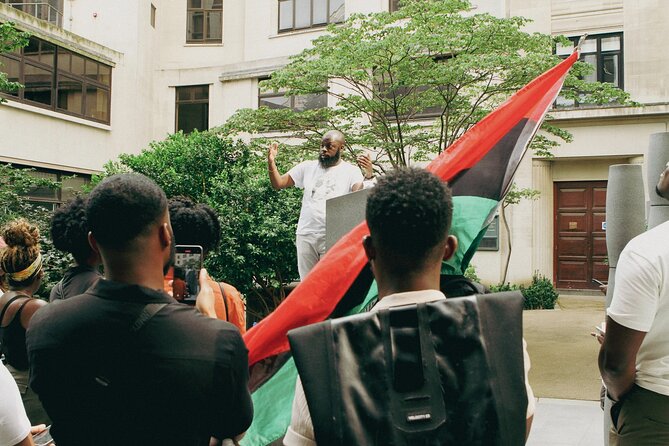
The tone is direct rather than softened for comfort. Darrel Blake presents difficult facts plainly, brings in personal experience and artifacts, and asks questions that make you check what you have just heard. That style suits people who want an active discussion, not a speech delivered over their heads.
A few more London trips to weigh up
- City Sightseeing London Hop-On Hop-Off Bus Tour & Bookable Extras
★ 4.0 · 1,224 reviews - Eating London: The Heart of ‘The City’ Food Tour
★ 5.0 · 206 reviews - London Luxury Dinner Experience with Panoramic City Views
★ 4.5 · 174 reviews
Meeting Darrel Blake at the Royal Exchange
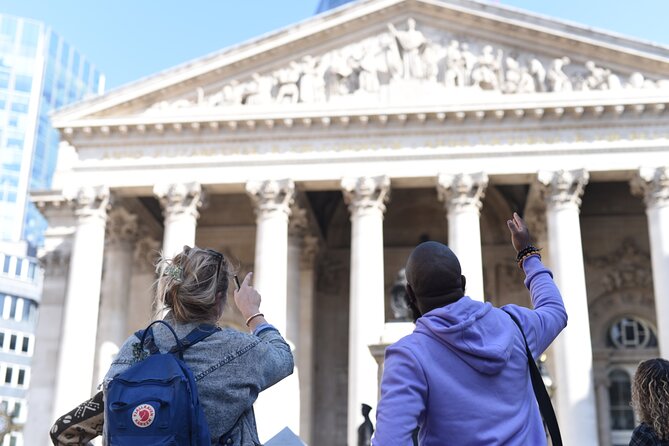
The tour starts at noon outside the Royal Exchange, London EC3V 3LL. This is a practical meeting point in the Bank area, close to public transport and surrounded by some of the City’s most recognizable financial buildings.
Darrel Blake is the listed guide and the central strength of the walk. His presentation is clear and firm, with a strong focus on evidence and the links between familiar London institutions and the slave trade.
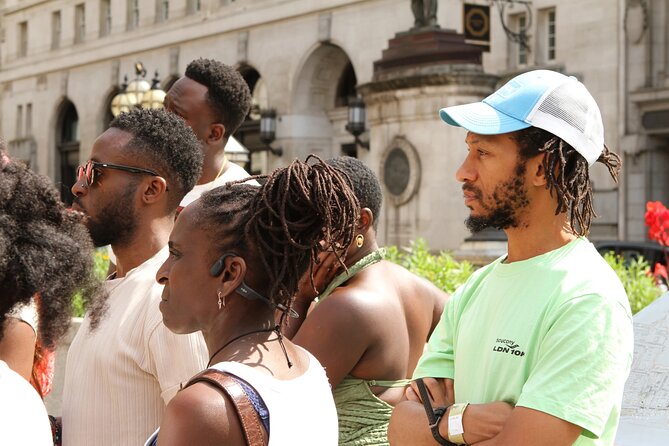
You can expect him to involve the group with questions rather than simply speaking for three hours without pause. That matters on a serious subject. Active participation helps you remember the names, relationships, and financial connections being explained.
Several people who joined the walk with teenagers found the format useful for younger minds. Children aged 13 and 15 were able to follow the material, and school friends in a larger private group found the discussion suitable for learning about material that had not been covered in their education.
That does not mean the topic is easy. The walk deals with exploitation, forced labor, racial injustice, and the impact of slavery on later generations. You should prepare children for serious material before booking, especially if they are sensitive to graphic or distressing subjects.
Stop one: the Bank area and London’s financial power
The opening section takes place in the historic Bank area of the City of London. For about 15 minutes, you begin to identify financial institutions connected to the transatlantic slave trade.
This is a good place to start because the setting looks so modern and powerful. You are surrounded by the machinery of money, yet the connections being discussed reach back centuries. The contrast between today’s offices and the older sources of wealth gives the first part of the walk its force.
The guide’s task here is to show that the trade was not carried out only by ship captains and plantation owners. Financial backing, credit, investment, and commercial networks were also needed. London institutions helped make those systems possible.
The short time at this first stop keeps the opening focused. You will not get a full lecture on every bank or company, but you should come away with a framework for the rest of the route.
Stop two: the Royal Exchange and commercial ambition
The Royal Exchange receives about 20 minutes. This grand building was once the centre of London’s commercial life, and the tour explains how that world helped support trade connected to slavery.
The building is worth seeing even on a standard City walk. Here, however, its role changes from architectural landmark to evidence of commercial power. The setting helps you understand how trade was organized, financed, and given respectability by the institutions around it.
I like this stop because it challenges the easy division between respectable business and brutal exploitation. Goods, credit, insurance, shipping, and investment could all be parts of the same system. The men and companies involved did not need to be present on a plantation or aboard a slave ship to benefit from the trade.
You receive a tour booklet to support the visit. It can help you keep track of names and ideas, and it gives you something to revisit after the walk. If you enjoy taking notes, this is a good point to record the connections that seem most surprising.
Same country, a completely different day out:
- Stonehenge, Windsor Castle, and Bath from London
★ 4.5 · 18,662 reviews - London Big Bus Hop-On Hop-Off Tour with Optional River Cruise
★ 3.5 · 10,803 reviews - London Small Group Tour of Historical Pubs
★ 5.0 · 10,422 reviews - Stonehenge, Windsor Castle and Bath with Pub Lunch in Lacock
★ 4.5 · 7,402 reviews
Stop three: Fenchurch Street and the shipping network

The longest stop is at 20 Fenchurch Street, where you spend about 50 minutes examining the area’s ties to shipping and major companies that profited from the trade.
This is where the money trail becomes especially practical. Shipping did not operate on its own. It required merchants, offices, investors, insurers, cargo arrangements, and a network of businesses based in or linked to London.
The stop gives Darrel time to explain how the British economy became involved in the transatlantic trade and how commercial wealth helped shape the City. You may find this section the most useful if your interest is in economics, business, or the mechanics of empire.
It is also likely to be the most information-heavy part of the walk. The guide is praised for a large body of research and for backing his claims with proof, but you should be ready to concentrate. Names, companies, dates, and financial connections can add up quickly.
Darrel’s questioning style helps. Rather than letting the group drift, he checks that people have understood the point before moving on. If you have a question, this longer stop gives you the best chance to raise it and discuss it.
Stop four: Lloyd’s of London and the cost of risk

The walk then reaches Lloyd’s of London for about 20 minutes. Here, you examine the insurance side of the transatlantic slave trade.
Insurance can feel like an abstract subject, especially compared with the human suffering at the heart of the trade. Yet it was a key part of making long-distance commercial ventures possible. Ships, cargoes, and financial investments carried risk, and insurance helped businesses protect themselves against loss.
This stop shows how an institution associated with careful risk management could be connected to a system built on the ownership and forced transport of human beings. That contrast is uncomfortable, and it should be.
The building itself is another reason the stop works well. You are not looking at an isolated museum display. You are seeing a present-day institution in the place where London’s commercial systems developed.
The guide’s broader point is that slavery was not a side note to London’s growth. It was linked to the structures that helped create wealth and strengthen the power of commercial elites. That gives this part of the walk lasting value for anyone trying to understand Britain’s imperial past.
Stop five: Borough Market and the goods people bought
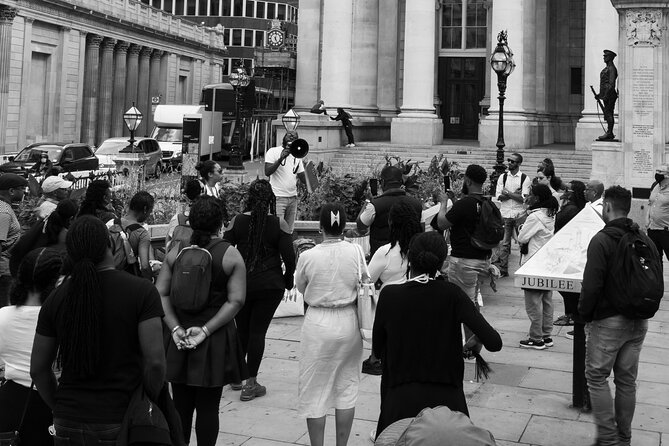
The final stop is Borough Market in Southwark, with about 20 minutes focused on the connection between consumer goods and enslaved labor.
Sugar and tobacco are important examples here. They were not distant concepts for people in Britain. They entered homes, shops, kitchens, and social life, which means ordinary consumption helped sustain demand for goods produced under brutal conditions.
Borough Market is still a busy public place, so the atmosphere changes from the office streets of the City. That contrast helps bring the subject down from high finance to everyday buying and selling.
The market is also the ending point, so you can continue exploring Southwark afterward. Keep in mind that no market admission or food is included, and lunch is not part of the tour. Since the walk ends around Borough Market, you may want to plan a meal there after the formal tour finishes.
The route ends at Borough Market, London SE1 9AL, rather than returning to the starting point. That is useful if you plan to continue toward Southwark, but less convenient if you have left belongings near Bank.
What Darrel Blake adds to the walk
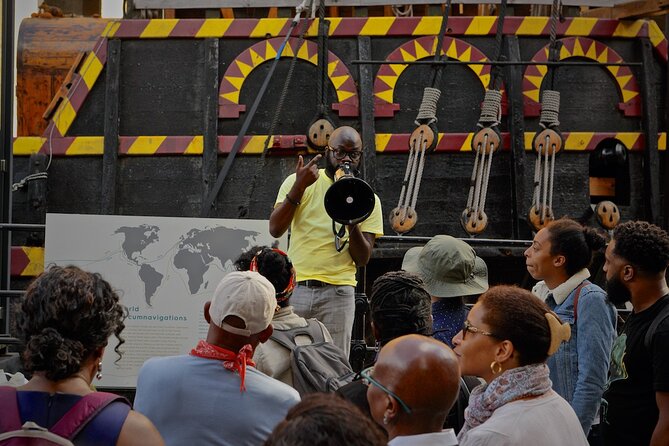
The guide’s delivery is one of the clearest reasons to choose this experience. Darrel speaks in a direct and personal way, while keeping the material focused on evidence and historical connections.
He also uses artifacts during the presentation. These objects give the story a physical dimension, although the available information does not specify exactly what each artifact is. You should think of them as supporting material rather than a substitute for a museum collection.
The discussion can become emotional. One of the most valuable parts of the tour is its attention to the people whose experiences are often left out of standard accounts of London’s development.
Darrel also connects the past with present-day questions about heritage, inequality, diversity, and social justice. That makes the walk more than an account of abolition or old trading firms. It asks you to consider how wealth and power carried forward after the trade ended.
The approach is not neutral in the sense of pretending every side has equal moral weight. It is unapologetic about the damage caused by slavery. For some people, that directness will be exactly what they want. If you prefer a quiet, detached presentation, you may find the style intense.
Price, length, and the value of the walk
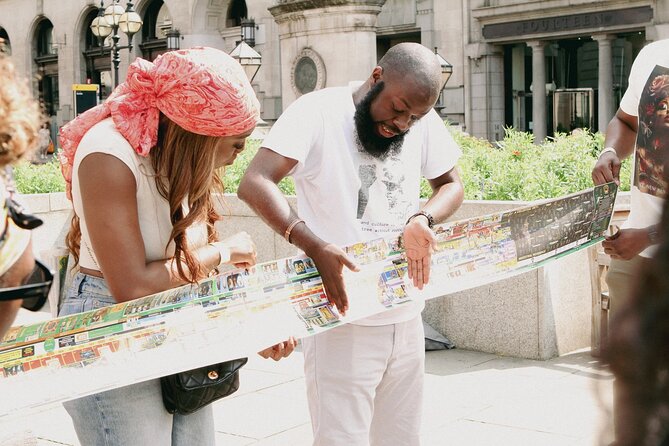
The price is $48.01 per person for about three hours. That is more than you would pay for a free self-guided walk through the City, but the value lies in the guide’s interpretation, the booklet, the discussion, and the research connecting separate locations.
All listed stops have no admission charge, apart from the fact that Borough Market is noted as not included. You are paying for the guided historical framework, not for entry to a museum or special access inside each building.
At roughly $16 per hour, the price is reasonable for a focused specialist tour, especially if you are interested in slavery, colonialism, London finance, or social justice. It is less suitable if you want general sightseeing, interior visits, or a relaxed route with lots of free time for photographs.
The maximum group size is 30. That is not a private walk, but it is small enough for questions and discussion if everyone stays engaged. The tour is offered in English and uses a mobile ticket.
It is booked an average of 42 days ahead, which suggests that planning early is sensible. Confirmation arrives when you book, and free cancellation is available up to 24 hours before the start time.
Practical advice for the three-hour route
Wear comfortable shoes. The route covers several areas between the City and Southwark, and the listed stop times add up to about two hours and five minutes, leaving the rest of the three-hour period for walking and explanation between locations.
Bring your own bottled water because it is not included. Lunch is also not included, though the ending at Borough Market gives you a convenient place to arrange food afterward.
The tour requires good weather. If poor weather causes cancellation, you are offered another date or a full refund. A raincoat is still sensible for London, but do not assume the walk will run in every condition.
The route is near public transport, and most people can participate. Service animals are allowed. Since the walk begins at the Royal Exchange and ends at Borough Market, check your plans for the rest of the day before booking.
A mobile ticket keeps the arrival simple. I would still save the meeting address and start time somewhere easy to find, especially if you are coming through a busy station or navigating the City for the first time.
Who should book this experience?
I would choose this walk if you want London history with a clear social and economic focus. It suits history buffs, people researching Caribbean or African heritage, students, educators, and anyone who wants to understand how slavery affected Britain beyond the plantation itself.
It can work well for families with older children. The guide’s questions and clear explanations make it possible for teenagers to take part, but parents should explain beforehand that the subject includes cruelty, exploitation, and loss.
The tour is also useful for people who already know central London. Familiar landmarks gain a different meaning when you learn about their links to shipping, insurance, finance, and consumer goods.
I would skip it if you are looking for royal history, architecture, shopping, or a cheerful introduction to London. This walk asks you to listen closely and sit with difficult facts. It is rewarding, but it is not easy entertainment.
Should you book the Slave Trade Money Trail Tour?
Book it if you want a serious, place-based account of how London’s wealth was connected to the transatlantic slave trade. The combination of the Royal Exchange, Fenchurch Street, Lloyd’s of London, and Borough Market gives the subject a strong physical structure, while Darrel Blake’s questioning style and artifacts make the three hours active rather than passive.
At $48.01, the tour offers fair value for a specialist experience with a guide and booklet. Plan for weather, carry water, wear good shoes, and leave room in your day for the walk to end in Southwark.
This is best chosen with an open mind and enough time afterward to reflect. If you want to understand London’s financial past and its continuing human consequences, I would book it.
FAQ
How much does the Slave Trade Money Trail Tour cost?
The listed price is $48.01 per person.
How long does the tour last?
The walking tour lasts approximately three hours.
Where does the tour begin?
It begins at the Royal Exchange, London EC3V 3LL, at 12:00 pm.
Where does the tour end?
The tour ends at Borough Market, London SE1 9AL.
What language is the tour offered in?
The tour is offered in English.
How many people can join the tour?
The maximum group size is 30 people.
What happens if the weather is poor?
The experience requires good weather. If it is canceled because of poor weather, you will be offered a different date or a full refund. You can also cancel up to 24 hours before the start time for a full refund.
Just added around London
- Private The Beatles Taxi Tour in London★ 5.0 · 12 reviews
- Dinner and Jazz Cruise on the River Thames★ 4.0 · 140 reviews
- Airport Coach Service from Heathrow to Oxford★ 3.5 · 67 reviews
- The Alfred Hitchcock London Walk with Sandra Shevey★ 5.0 · 15 reviews
- Tower of London & 30+ London Sights Walking Tour★ 4.5 · 33 reviews
- Thames Beachcombing★ 4.5 · 100 reviews
- Ted Lasso Tour of Richmond★ 5.0 · 152 reviews
- Ted Lasso London Taxi Tour★ 5.0 · 5 reviews
City Tours, compared.

Liverpool City Sights Hop On Hop Off City Tour – 24hr Ticket
Read our review →
1.5-hour Oxford City and University Walking Tour
Read our review →
City Sightseeing London Hop-On Hop-Off Bus Tour & Bookable Extras
Read our review →
City Sightseeing Oxford Hop-On Hop-Off Bus Tour
Read our review →
Browse the lists this tour appears in