
Reviewed · CITY TOURS
Secret Gardens of the City of London Private Tour
London’s best surprises often sit behind an ordinary doorway or beside a busy office street. This private three-hour walk takes you through 25 small gardens, churchyards, ruins, lanes, and courtyards in the City of London, beginning beneath St. Paul’s Cathedral and ending at the meeting point.
I like the way the route links quiet green spaces with big London stories, from Samuel Pepys at Seething Lane to the Great Fire Monument and the Roman amphitheatre beneath Guildhall. I also like the private format, which lets guides such as Stephen and Kevin adjust their stories to your interests. The main drawback is that these are mostly public churchyard gardens, not locked private gardens, and several stops take only five minutes.
Key things to know before you book
- Twenty-five stops in three hours: Expect a brisk walking route with short visits rather than long breaks in each garden.
- A history-led walk: The gardens are the setting for stories about Roman London, the Great Fire, the Blitz, Shakespeare, slavery, religion, and daily life.
- Private guiding with Stephen or Kevin: Their storytelling and ability to tailor the walk are central to the experience.
- A quiet side of central London: Back lanes, churchyards, and small planted spaces offer a striking contrast to the City’s office towers.
- Hotel pickup is available: The guide can meet you at a Central London hotel and travel by Tube with you to St. Paul’s.
- Good for repeat London visitors: You can see places even frequent visitors often miss, including Noble Street, St. John Zachary, and Postman’s Park.
What this City of London walk is really about
The title needs a little explanation. You are not entering residents’ locked gardens or private backyards. The secret gardens are small public spaces, many of them former churchyards or old burial grounds, tucked among streets that most people cross without noticing.
That distinction matters. If you want elaborate flower displays or grand country-house gardens, this is not the right outing. The planting in several spaces is modest, and some gardens are small enough to cross in a minute or two. The appeal comes from the setting and the story: a water feature beside a medieval church, Roman ruins under modern offices, or a quiet memorial hidden in the middle of the Square Mile.
The walk is led in English and is private to your group. It costs $260.51 per person, so the value depends on your group size and your interest in personal guiding. For one or two people, it is a considerable spend. For a family or small group sharing the guide, the cost buys a focused route, hotel pickup, and the freedom to ask questions without keeping pace with strangers.
A few more London trips to weigh up
- The Premier Classic London: Private 4-Hour Tour in a Black Cab
★ 5.0 · 2,737 reviews - Stonehenge Inner Circle Private Tour from London with Bath Visit
★ 5.0 · 1,909 reviews - Private Tour: Black Taxi Tour of London
★ 5.0 · 1,153 reviews
Starting beneath St. Paul’s Cathedral
The meeting point is Caffè Nero at 30 Newgate Street, near Paternoster Square. If you arrange hotel pickup, the guide can meet you at any Central London hotel, then accompany you by Tube to the start.
The tour begins under the impressive presence of St. Paul’s Cathedral. You do not go inside as part of the standard route, and admission to the cathedral is not included. Instead, the cathedral gives the opening walk a clear sense of place while the guide sets up the story of the City.
You then enter St. Paul’s Churchyard, where landscaped gardens soften the hard stone and traffic around the cathedral. Festival Gardens follows, with colorful planting and a fine cathedral backdrop. These first stops are brief, so keep your camera ready and listen closely rather than expecting time to sit.
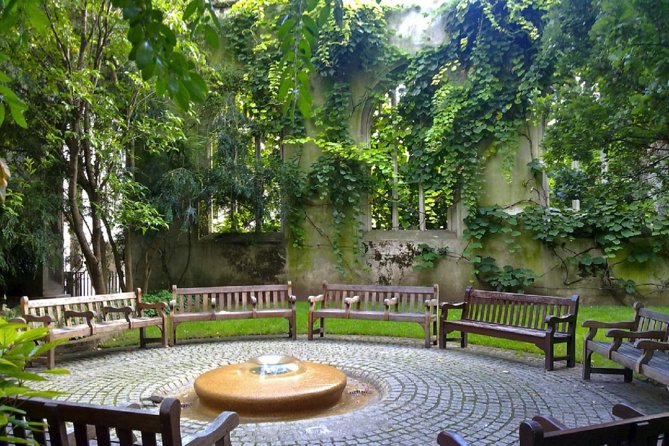
The Reflection Garden was redeveloped during the Covid period and includes a water feature. Distaff Lane Garden is shadier, with silver birch and another cooling water feature. These spaces show the pattern of the tour: each garden is small, but each has a different mood and a reason for being there.
From Roman ruins to Whittington’s garden
Cleary Garden has an Italian influence linked to Roman ruins below the City. It is a useful reminder that modern London sits on layers of older settlements. You may find the planting more attractive here than at some of the smaller churchyards, but the Roman connection is the real reason to pay attention.
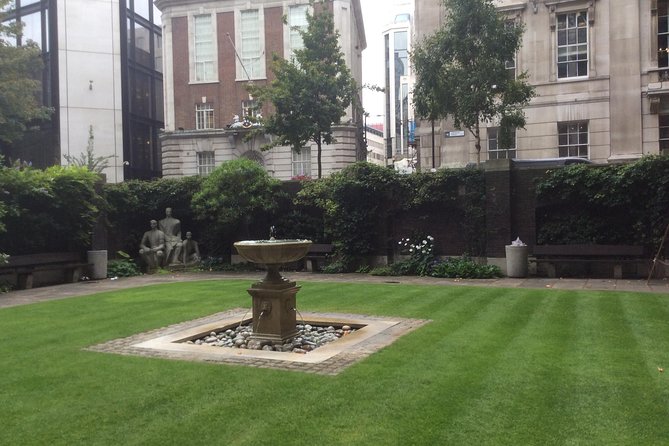
Whittington Garden honors Richard Whittington, one of London’s best-known lord mayors. The nearby church adds context to the garden, and the stop helps turn a name from a nursery rhyme or history book into a person connected to this exact patch of the city.
St. Swithin London Stone Church Garden is almost completely out of sight from the main flow of the street. It carries a Welsh theme and a sad story, giving the route one of its more reflective moments. The garden itself is not large, but the setting rewards you for noticing how easily a quiet space can disappear inside the City.
The Monument to the Great Fire of London comes next. Admission is not included, and the visit is brief, so you should not expect to climb it on this tour. You do, however, get a direct connection to one of London’s defining disasters before moving on to the atmospheric remains of St. Dunstan in the East.
St. Dunstan in the East and Pepys’s old neighborhood
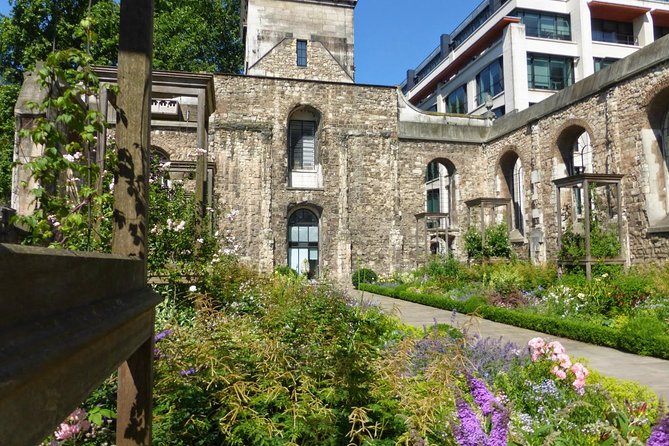
St. Dunstan in the East is the visual highlight for many people. The church ruins are wrapped in greenery, creating a striking meeting of broken stone and living plants. Admission is included, and the ten-minute stop gives you enough time to look around and take photographs.
It is also one of the few places on the route that feels like a major sight rather than a quick urban pause. Still, ten minutes goes fast. If you are a keen photographer, you may wish for more time, but the private format lets you ask the guide for the best angle and hear the story without a large group blocking the view.
At Seething Lane Garden, the subject shifts to Samuel Pepys, the famous diarist who once lived nearby. Decorative stones illustrate episodes from his life, giving you something concrete to examine while the guide explains the connection. This is a good example of the tour’s method: the garden is not famous for its size, but it opens a door into a memorable London character.
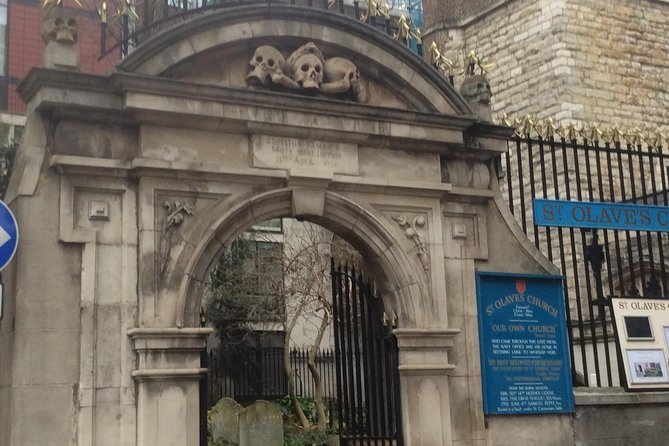
St. Olave’s Church and garden bring together the Great Fire, plague, and the two World Wars. The church has survived repeated upheaval, and the stop adds religious and social history to the route. You receive admission to the garden area, but this is still a short visit rather than a full church tour.
Same country, a completely different day out:
- Stonehenge, Windsor Castle, and Bath from London
★ 4.5 · 18,662 reviews - London Big Bus Hop-On Hop-Off Tour with Optional River Cruise
★ 3.5 · 10,803 reviews - London Small Group Tour of Historical Pubs
★ 5.0 · 10,422 reviews - Stonehenge, Windsor Castle and Bath with Pub Lunch in Lacock
★ 4.5 · 7,402 reviews
From medieval darkness to a modern rooftop view
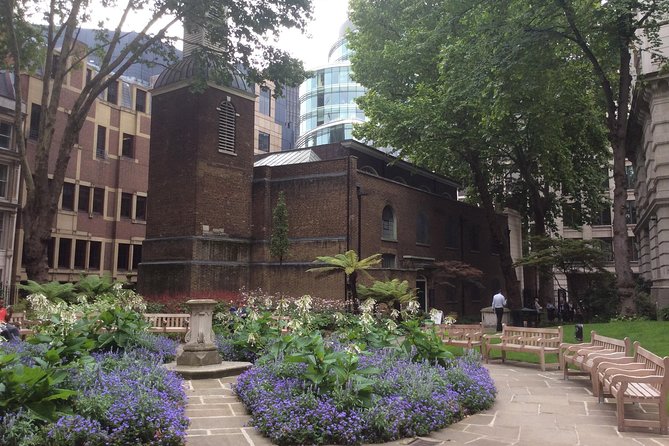
All Hallows Staining Church Tower Garden is being redeveloped, but its real interest lies in why the space exists. The story reaches back to a dark period in London’s past, making this a stop where the guide’s explanation matters more than the planting.
Garden at 120 changes the mood completely. This modern sky garden offers a broad view over the City and the route you have already walked, as well as the streets ahead. Admission is free, but access is not guaranteed because the garden has a capacity of 207 people. It is usually possible to enter, yet you should treat the view as a welcome bonus rather than an absolute promise.
This is one of the route’s most useful pauses because it helps you understand the City from above. After seeing narrow lanes and small gardens at street level, you can look across the dense cluster of buildings and see how close the old and new parts of London sit together.
Hogarth Court offers another change of subject. A modern garden contains a serious work of art connected to the slave trade and two men who campaigned against it. The stop is quiet and thoughtful, showing that the City’s past includes commerce and power as well as churches and royal events.
Leadenhall Market and ancient churchyards
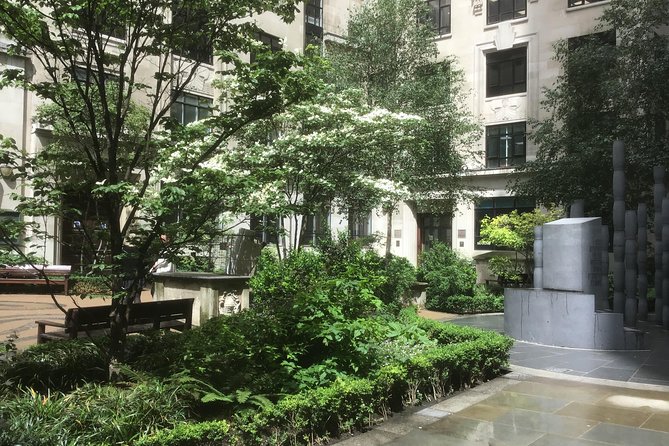
Leadenhall Market is one of London’s most recognizable covered markets. Its Victorian structure was built above a Roman market, and its ornate architecture has appeared in television programs and films. The visit is short, but the market gives you a lively architectural contrast to the small gardens.
At St. Peter-upon-Cornhill, the garden is relatively plain. Its importance comes from a grave that may be among the most famous in English literature, set among old lanes and alleys. This is a stop where you will get more from the explanation than from the appearance of the garden itself.
St. Michael’s Cornhill is reached through medieval passageways where cars and other vehicles cannot get close. The garden has a sunny spot and is surrounded by old churches, pubs, and the city’s oldest coffee shop. Again, the charm is not grand scale. It is the sense that you have stepped a few paces away from the main streets without leaving central London.
The sequence also gives you a break from famous landmarks. Instead of moving from one headline sight to the next, you are asked to notice passages, church walls, graveyards, and small patches of greenery. That makes the tour especially useful if you already know the Tower of London, Westminster, and the main shopping streets.
Guildhall, St. Lawrence Jewry, and Roman London
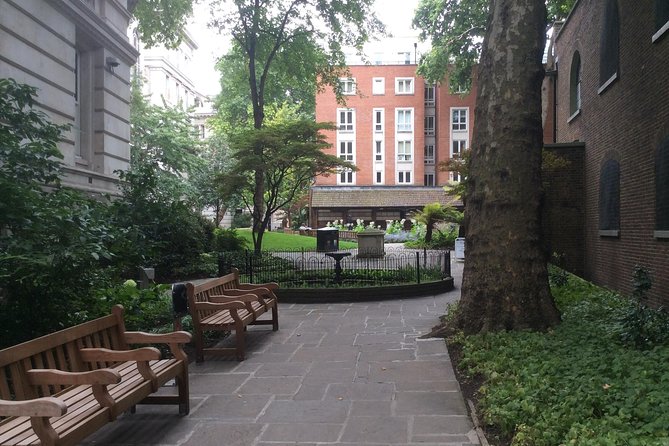
Guildhall takes you to the center of Roman London. The visit includes the remains of the Roman amphitheatre beneath the present-day city. This is one of the strongest history stops because the modern civic setting makes the ancient footprint easy to overlook.
St. Lawrence Jewry is a small space in the old Jewish district of London. The church was almost entirely rebuilt after the Second World War, so the stop opens a conversation about wartime destruction and reconstruction. Admission is included, though the ten-minute visit means you should focus on the key details rather than expect a long architectural inspection.
The churchyard of St. John Zachary is a sunken garden with both ancient and more recent layers of history. Its lower position gives it a different feel from the street, and the included admission allows you to enter rather than simply view it from outside.
Noble Street contains unusual gardens built around an old Roman city wall uncovered during the Second World War. This is precisely the sort of place that can disappear from an ordinary London day. The ruins are not presented as a huge archaeological site, but their presence among modern buildings makes the stop memorable.
Shakespeare, Churchill, and the heroes of Postman’s Park
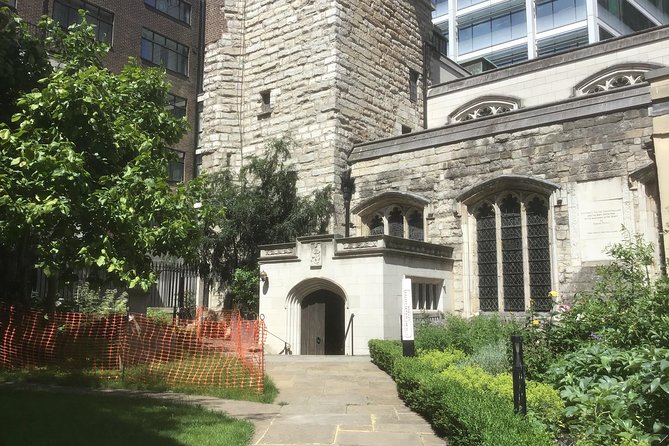
St. Mary Aldermanbury Garden has links to William Shakespeare and Sir Winston Churchill. Admission is included, and the ten-minute stop gives the guide room to connect literary London with more recent political history.
St. Mary Staining is known for a magnificent old tree set against modern architecture. The contrast is simple but effective. It is another reminder that the City is not one period preserved intact. Ancient churches, old trees, glass towers, and office blocks share the same few streets.
Postman’s Park is the emotional finish for many people. It contains a memorial to ordinary men and women who died while saving others. The memorial gives names and short accounts of everyday courage, making it more personal than a grand monument to kings or generals.
The guide Stephen has written a book about Postman’s Park and has a particular connection to its memorials. If this stop interests you, ask him about the people remembered there. The park is rarely part of a first-time London route, yet it offers one of the most human moments of the walk.
Pace, guiding, and the private format
The official duration is about three hours, with most stops lasting five or ten minutes. That adds up to a steady walking pace. You are not rushing from sight to sight, but you are rarely lingering for long either.
A moderate level of fitness is advised. The route includes urban walking, old lanes, churchyards, and changes in surface that may be less comfortable for anyone who tires easily. Wear sensible shoes and smart-casual clothing. The experience is near public transport, but transportation between attractions is not included.
The strongest part of the tour is the guide. Stephen and Kevin are repeatedly praised for their passion, storytelling, and ability to explain London’s past in a lively way. Kevin is known for adjusting the walk to the interests of the group, while Stephen brings special knowledge of Postman’s Park and the City of London.
Because the tour is private, you can ask about a particular church, character, or period instead of listening to a fixed script. That matters on a route with so many stops. It also means you should speak up if you want more time at St. Dunstan in the East, Garden at 120, or Postman’s Park.
One practical improvement would be a small printed checklist of the gardens. With 25 stops, it is easy to forget names such as Distaff Lane, St. John Zachary, or St. Mary Staining once the day is over. Take your own notes or photos of signs if you want a record of the route.
Is $260.51 per person fair?
The price is high for a three-hour walking tour, especially for a couple. You are paying for a private guide, not for expensive admissions or transport. Most gardens are free, several admissions are included, and the guide does not provide transportation between the sites.
The value improves for a family or small group because the same guide serves only your party. Hotel pickup also saves you from finding the start point, though the transfer to St. Paul’s is by Tube rather than private vehicle. If you prefer a cheap overview of London’s main landmarks, spend your money elsewhere.
I think the price makes sense when you care about stories, quiet corners, and personal attention. It is less convincing if you want a leisurely garden visit, formal botanical information, or a tour built around major indoor attractions.
Who should book this walk?
I would choose this tour for a repeat visitor who has already seen the big sights and wants to understand the oldest part of London at street level. It also suits history fans, photographers, families with older children, and small groups who enjoy asking questions.
The route works best for people who can appreciate a small garden with a strong story. You should not book it expecting private residential gardens, extensive flower beds, or long stops at each location.
The start time is 9:30 a.m., though a later start around 10:30 or 11 a.m. may help you avoid rush hour. The provider has also suggested meeting at the start point rather than using public transport during periods of health concern. Service animals are allowed, and the activity is private to your group.
Should you book the Secret Gardens of the City of London Private Tour?
Book it if you want a guide-led walk through the City’s overlooked corners and you value context more than grand scale. The Roman wall on Noble Street, Pepys’s garden, St. Dunstan in the East, and Postman’s Park create a strong mix of archaeology, architecture, tragedy, literature, and quiet beauty.
Skip it if the phrase secret gardens makes you expect locked private spaces. These are public gardens, churchyards, and civic spaces, and several are modest. For the right audience, that is the point: you see London as a layered working city, not just a collection of famous monuments.
FAQ
How long does the Secret Gardens of the City of London tour last?
The tour lasts approximately three hours.
What time does the tour start?
The scheduled start time is 9:30 a.m. A later start around 10:30 or 11 a.m. may be suggested to avoid rush hour.
Where does the tour start?
It starts at Caffè Nero, 30 Newgate Street, Paternoster Square, London EC4M 8AD.
Is hotel pickup available?
Yes. The guide can meet you at any Central London hotel, then travel with you by Tube to the starting point at St. Paul’s.
Is transportation between the attractions included?
No. Transportation to and from the attractions is not included. Hotel pickup includes accompanying you by Tube to the starting point.
Is this a private tour?
Yes. Only your group participates in the activity.
Which language is the tour offered in?
The tour is offered in English.
Are admission tickets included?
Admission is included at St. Dunstan in the East, Guildhall, St. Lawrence Jewry, St. John Zachary, St. Mary Aldermanbury Garden, and Postman’s Park. Admission is not included at St. Paul’s Cathedral, the Monument to the Great Fire of London, or All Hallows Staining Church Tower. Most other listed gardens are free.
What happens if the weather is poor?
The experience requires good weather. If it is canceled because of poor weather, you will be offered another date or a full refund. You can also cancel up to 24 hours before the start time for a full refund.
Just added around London
- Private The Beatles Taxi Tour in London★ 5.0 · 12 reviews
- The Alfred Hitchcock London Walk with Sandra Shevey★ 5.0 · 15 reviews
- Dinner and Jazz Cruise on the River Thames★ 4.0 · 140 reviews
- Airport Coach Service from Heathrow to Oxford★ 3.5 · 67 reviews
- Tower of London & 30+ London Sights Walking Tour★ 4.5 · 33 reviews
- Thames Beachcombing★ 4.5 · 100 reviews
- Ted Lasso London Taxi Tour★ 5.0 · 5 reviews
- Ted Lasso Tour of Richmond with Private Guide★ 5.0 · 25 reviews
City Tours, compared.



Liverpool City Sights Hop On Hop Off City Tour – 24hr Ticket
Read our review →
1.5-hour Oxford City and University Walking Tour
Read our review →
City Sightseeing London Hop-On Hop-Off Bus Tour & Bookable Extras
Read our review →

City Sightseeing Oxford Hop-On Hop-Off Bus Tour
Read our review →
Browse the lists this tour appears in