Reviewed · PRIVATE
London in the Swinging 60s – Private Tour
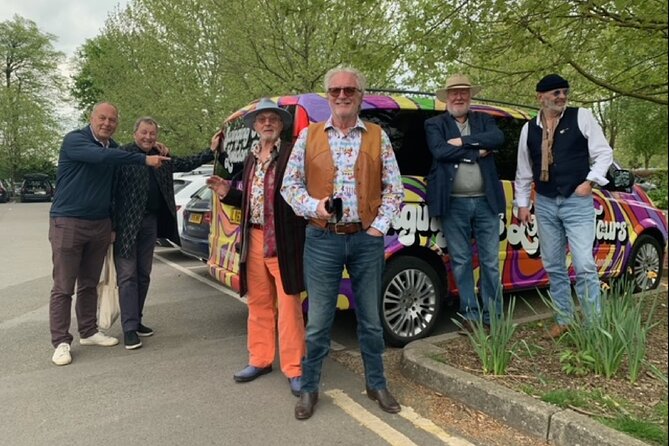
The most appealing part of this Swinging 60s London tour is its focus on real addresses rather than a general music-themed sightseeing loop. You ride through Chelsea and the King’s Road in a psychedelic minibus, stopping at former homes, studios, clubs, and fashion sites tied to The Beatles, Rolling Stones, Eric Clapton, Pink Floyd, and other figures from the decade.
I like the personal format, especially with guide Paul Endacott, whose commentary covers music, fashion, and the social scene. I also like the mix of famous names and lesser-known places, from the Beatles’ early London base near Sloane Square to the small Troubadour venue. The main consideration is time: at roughly 90 minutes, most stops are brief exterior looks, not long visits.
Key points before you book
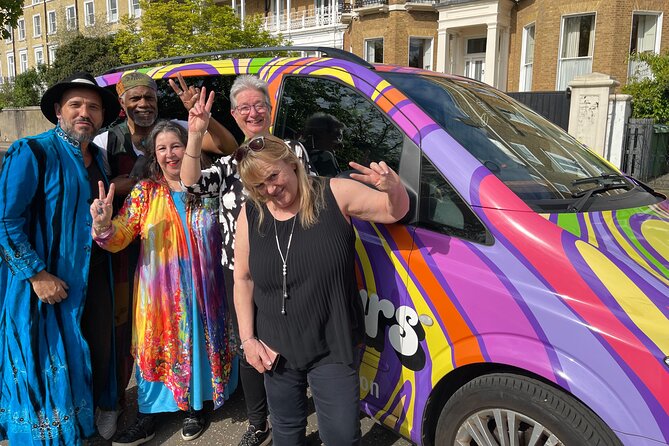
- Ride through Chelsea in a psychedelic minibus: The vehicle gives the experience its 1960s character and keeps the group together as you move between locations.
- Follow several music scenes at once: The route connects The Beatles, Rolling Stones, Eric Clapton, Pink Floyd, The Who, Bob Dylan, Jimi Hendrix, and others.
- Stop at the Troubadour: You get about 15 minutes at one of London’s most important surviving music venues from the era.
- Hear more than Beatles stories: Fashion, recording studios, clubs, homes, and the wider social scene all feature in the commentary.
- Private touring gives you a say: Your group travels alone, making this a good choice for families, birthday outings, or visitors with a particular band in mind.
- Plan for a short, compact experience: The tour begins and ends at the Royal Court Theatre at 11 a.m. and lasts about an hour and a half.
Why Chelsea is the right place to tell the story
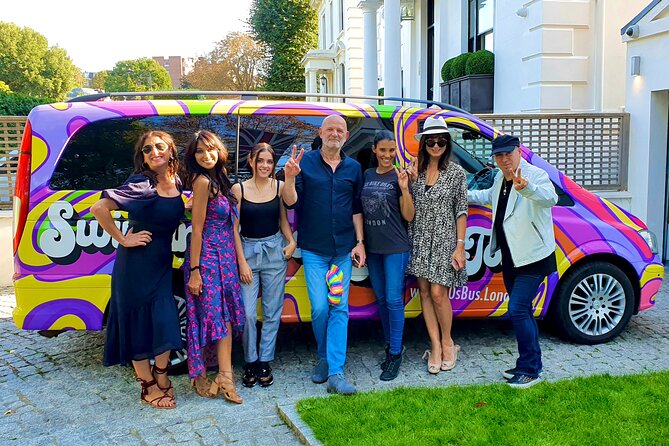
The tour starts at the Royal Court Theatre on Sloane Square, a useful meeting point in central London. From here, you move into Chelsea, the district that became one of the key stages for 1960s music, fashion, and youth culture.
This was not simply a place where famous musicians rented rooms. The King’s Road and nearby streets brought together new clothes, new sounds, artists, photographers, clubs, and independent shops. That mixture is important. The tour is not just a list of celebrity addresses. It shows how several creative worlds met in a relatively small part of London.
I find that setting more interesting than a tour built around isolated houses scattered across the city. You can connect the locations as neighborhoods, not just as map pins. At the same time, you should know that some stops are very quick. The value comes from Paul’s explanation and the sequence of places, not from spending time inside each one.
A few more London trips to weigh up
- The Premier Classic London: Private 4-Hour Tour in a Black Cab
★ 5.0 · 2,737 reviews - Stonehenge Inner Circle Private Tour from London with Bath Visit
★ 5.0 · 1,909 reviews - Private Tour: Black Taxi Tour of London
★ 5.0 · 1,153 reviews
Sloane Square and the Beatles’ first London base
The first stop is at Sloane Square, where you see the hotel The Beatles used as their first London base in the early 1960s. It is a short two-minute stop, and admission is not included, so think of it as an exterior viewing point with commentary.
The location gives you a useful starting point. The Beatles’ London story began before the band became a global symbol, and seeing an early base helps place them in the city they were entering. It also sets up the wider theme of the tour: London was a working city for these musicians, filled with hotels, flats, clubs, shops, studios, and cafés.
This is not a Beatles-only experience. If you want a detailed account of every recording session or a long visit inside a Beatles attraction, choose a different tour. If you enjoy seeing where the story took place and hearing how the musicians fitted into London life, this is a strong opening.
The King’s Road and fashion’s part in Swinging London
The next section brings you to the heart of Swinging London. The King’s Road became closely linked with 1960s fashion and design, including Mary Quant’s Bazaar and Granny Takes A Trip, described as London’s first psychedelic boutique.
These sites matter because music did not develop separately from fashion. The changing look of the decade helped create the public image of its bands and young fans. Mary Quant’s shop points toward the sharp, modern clothing that defined the period, while Granny Takes A Trip represents the more colorful psychedelic side.
You also get a better sense of why this tour appeals to people who are interested in more than rock music. The commentary includes fashion as well as bands, and that makes the King’s Road more than a backdrop. It becomes part of the story.
Some original shops and interiors may no longer be available as visitor attractions, so do not expect a museum-style presentation. You are seeing the streets and locations as they are now while using the guide’s stories to picture their earlier role.
The Pheasantry and Eric Clapton’s Chelsea years
The Pheasantry is a very brief stop, lasting about a minute. Here, you see Eric Clapton’s old flat from his years with Cream.
A one-minute stop may sound too short, but it fits the rhythm of the route. This is an address to identify, not a site where you spend an afternoon. The useful part is the connection between the place and Clapton’s life during a major period in his career.
For me, this stop works best as part of the chain of addresses. You move from early Beatles London to fashion sites and then to the homes of musicians who shaped the decade in different ways. The tour keeps showing how close these people and scenes were to one another.
If mobility is a concern, note that the published schedule does not describe long walking visits at each stop. Still, the activity takes place in a minibus, and the information does not specify step-free access or the exact boarding arrangements. Ask the operator for details if that matters to you.
Same country, a completely different day out:
- Stonehenge, Windsor Castle, and Bath from London
★ 4.5 · 18,662 reviews - London Big Bus Hop-On Hop-Off Tour with Optional River Cruise
★ 3.5 · 10,803 reviews - London Small Group Tour of Historical Pubs
★ 5.0 · 10,422 reviews - Stonehenge, Windsor Castle and Bath with Pub Lunch in Lacock
★ 4.5 · 7,402 reviews
Old Church Street, recording studios, and present-day connections
Old Church Street receives about five minutes, making it one of the more substantial stops before the Troubadour. You see Eric Clapton’s current London home and the location of a recording studio favored by Pink Floyd, Cat Stevens, The Who, and other 1960s figures.
This is a good example of how the tour moves beyond the most familiar Beatles and Stones material. A recording studio tells you something about the working life behind the songs. It also brings several major acts into one place, which gives Paul room to explain links between musicians and sessions.
The stop is described as free, but that does not mean you enter a private home or studio. Expect to view the location from outside and hear the story from the minibus or nearby. The precise experience can depend on traffic, parking, and what access is possible on the day.
Cheyne Walk and the Thames-side homes
At Cheyne Walk, the route follows the Thames and points out homes connected with music legends. This is a three-minute stop in one of London’s most exclusive areas.
The setting adds variety. After the shops and city streets of the King’s Road, you get a quieter riverside stretch and a sense of the neighborhoods where some musicians lived once their careers took off. The attraction here is the contrast between public fame and ordinary-looking residential streets.
Do not expect a long riverside walk or a full architectural tour. The schedule allows only a short pause, and admission is not included. Bring your attention to the guide’s details, since the buildings themselves may look understated.
Flood Street and the Sgt Pepper photograph
Flood Street offers a two-minute stop at the studio where The Beatles’ famous Sgt Pepper’s Lonely Hearts Club Band album photograph was taken in 1967. The stop is free and is another exterior look at a place tied to a well-known piece of pop culture.
This is one of the route’s best moments for Beatles fans because the connection is visual as well as musical. You can place the famous album image in a real London setting rather than treating it as a picture detached from the city.
The stop will be most satisfying if you already know the album cover. You may want to have it available on your phone before the tour, though the supplied details do not state that the guide provides images or printed material. The short duration means you should not expect time for a long photo session.
Edith Grove and the birth of the Rolling Stones
Edith Grove is linked with Mick Jagger, Keith Richards, and Brian Jones in 1962, the year the Rolling Stones were named. The stop lasts about two minutes and is free.
This is a compact but useful piece of rock history. Instead of focusing only on the Stones at the height of fame, the tour points to their early shared home and the stage when the band was still forming its identity.
The Edith Grove address also helps explain why a private tour can work well for a particular group. The guide can spend more time on the bands you care about, and the supplied experiences include private outings with an emphasis on the Rolling Stones. If your group has a favorite act, tell Paul when you book or at the beginning of the tour, though the exact ability to alter the route is not guaranteed.
The Troubadour, a 15-minute stop with real musical weight
The Troubadour is the longest stop, at about 15 minutes, and admission is included. It is presented as one of London’s key music venues, little changed from the period when Paul Simon, Bob Dylan, Jimi Hendrix, and many other musicians played and spent time there.
This is likely the emotional center of the tour. A former home can be meaningful, but a music venue connects directly with performance. You get a place where musicians gathered, played, and crossed paths, not only an address associated with one person.
Fifteen minutes is enough to look around and absorb the setting, but it is not a full concert or a long museum visit. The provided details do not say that food, drinks, or a live performance are included. Alcoholic drinks, coffee, and tea are specifically excluded, so treat the stop as part of the historical tour rather than a scheduled refreshment break.
What Paul adds to the ride
Paul Endacott is repeatedly identified as the guide for this experience and related 1960s music outings. His role is central because many of the stops are short and may not offer much on-site interpretation.
The strongest pattern in the supplied feedback is praise for his friendly, funny, engaging approach and his command of 1960s music and fashion. I would book this tour for the guide’s storytelling as much as for the addresses. You are not simply being driven past buildings. You are given the connections that make each building matter.
Paul’s commentary also appears to suit mixed-age groups. Families have used the experience for birthdays, including outings with parents, grandparents, and teenagers. That is useful if your group includes people who remember the 1960s and others who know the decade mainly through records, films, or family stories.
The tone seems interactive and adaptable, but you should keep expectations realistic. The tour lasts only 90 minutes, and the published route has a fixed set of stops. A bespoke focus may be possible on some private outings, but the standard information does not promise a fully custom route.
Psychedelic minibus, group size, and comfort
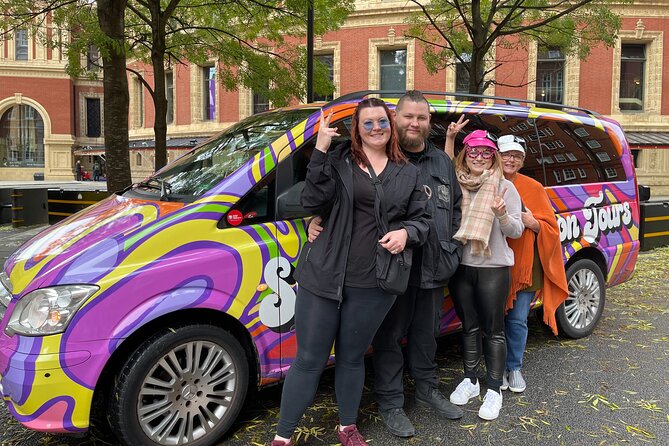
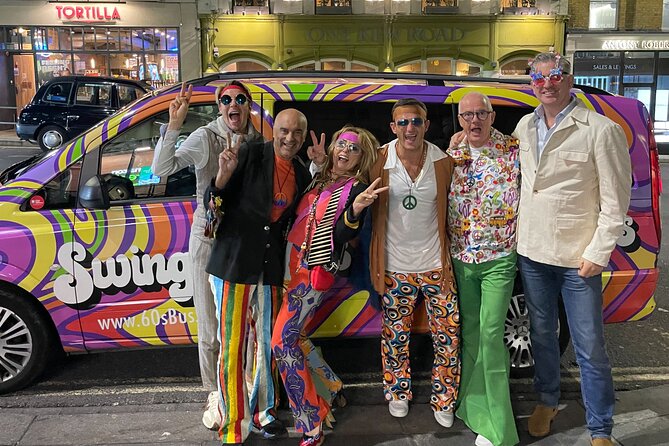
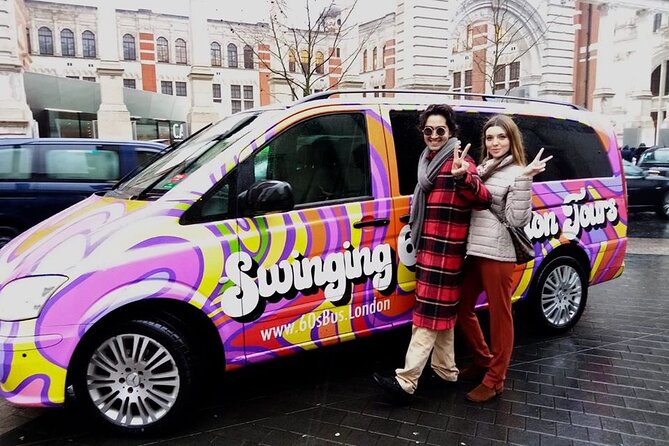
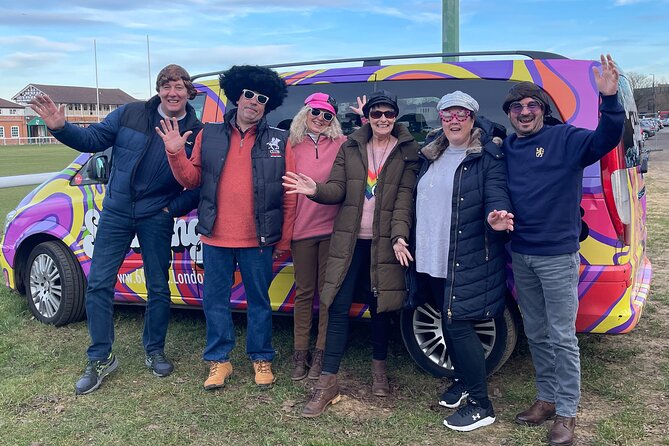
The psychedelic minibus is not just decoration. It helps create the mood and keeps the tour tied to the period. Several experiences connected with this provider also use a Beatles-inspired vintage-style bus, but this particular activity is described as a psychedelic minibus.
The vehicle is intended for a small group. The main tour details list a private group of up to six people at $397.75, while the highlights mention a maximum of eight. Because those numbers do not match, confirm the permitted group size before paying, especially if you have seven or eight people.
At the listed price, the cost is per group rather than per person. Six people would pay about $66 per person if the full group attends. Two people would pay nearly $199 each, so the value improves sharply with a larger party.
That pricing makes sense for a family celebration or a group of friends with a shared interest in 1960s London. It is harder to justify for a solo visitor or a pair who only want a broad introduction to London music. The private format, dedicated guide, themed vehicle, and Troubadour admission are the main reasons to choose it over a standard sightseeing bus.
Practical details for your morning
The tour begins at 11 a.m. outside the Royal Court Theatre, 50 to 51 Sloane Square, London SW1W 8AS. It returns to the same meeting point, so you do not need to arrange a separate pickup at the end.
Transportation to and from the meeting point is not included. You should allow extra time to reach Sloane Square, particularly if you are coming from another part of London. The tour has a mobile ticket, and confirmation is provided when the booking is confirmed.
The minimum age is nine. Service animals are allowed, and the meeting point is near public transportation. The published information says most people can participate, but it does not provide detailed vehicle-access information, so contact the provider if you need specific arrangements.
Free cancellation is available if you cancel at least 24 hours before the local start time. Cancellations inside that window are not refunded, and changes made within 24 hours are not accepted. Availability is checked after booking, with the card charged only once the tour is confirmed.
Who will get the most from this tour
I would choose this experience for a family birthday, a small group of Beatles or Rolling Stones fans, or anyone who wants to connect music with London streets. It also suits people interested in 1960s fashion, because Mary Quant, the King’s Road, and psychedelic boutiques receive attention alongside the bands.
It can work well across generations. Older family members may recognize the names and places, while younger people can see how music, clothing, clubs, and neighborhoods fed into one another. The minibus and short stops also keep the outing manageable for people who do not want a long walking tour.
I would be more cautious if you want indoor access, long visits, or a detailed museum presentation. Most stops are measured in one to five minutes, and the tour’s success depends heavily on your interest in the stories told along the way.
Should you book London in the Swinging 60s?
Book it if you want a focused, personable look at Chelsea’s 1960s music and fashion scene, especially if you can fill most of the group places. Paul’s commentary, the psychedelic minibus, the Beatles and Stones connections, and the Troubadour stop give the experience a clear identity.
Skip it if you prefer a large museum, a long walking tour, or a live music event. The route is compact, several stops are exterior views, and the price is much better for six people than for one or two.
For a small group with a strong interest in the British music scene, this is a lively way to spend 90 minutes in London. Go for the stories and the sense of place, not for extended sightseeing at each address.
FAQ
Where does the tour begin?
It begins at the Royal Court Theatre, 50 to 51 Sloane Square, London SW1W 8AS, UK.
What time does the tour start?
The scheduled start time is 11 a.m.
Where does the tour end?
The activity ends back at the meeting point at the Royal Court Theatre.
How long does the tour last?
The tour lasts approximately one hour and 30 minutes.
How much does the private tour cost?
The listed price is $397.75 per group, with the tour summary stating that the group can include up to six people.
How many people can join?
The tour is private, so only your group participates. The main pricing details state up to six people, while another tour description lists a maximum of eight. Confirm the exact limit before booking.
What is included in the price?
The price includes all taxes, fees, handling charges, and a professional guide. Admission to the Troubadour is also listed as included in the stop details.
Are drinks included?
No. Alcoholic beverages, coffee, and tea are not included.
Is there a minimum age?
Yes. The minimum age is nine years.
Can I cancel for a full refund?
Yes, if you cancel at least 24 hours before the experience start time. Cancellations made less than 24 hours in advance are not refunded, and changes within that period are not accepted.
Just added around London
- Private The Beatles Taxi Tour in London★ 5.0 · 12 reviews
- Dinner and Jazz Cruise on the River Thames★ 4.0 · 140 reviews
- Airport Coach Service from Heathrow to Oxford★ 3.5 · 67 reviews
- The Alfred Hitchcock London Walk with Sandra Shevey★ 5.0 · 15 reviews
- Thames Beachcombing★ 4.5 · 100 reviews
- Tower of London & 30+ London Sights Walking Tour★ 4.5 · 33 reviews
- Ted Lasso London Taxi Tour★ 5.0 · 5 reviews
- Ted Lasso Tour of Richmond with Private Guide★ 5.0 · 25 reviews
Private, compared.
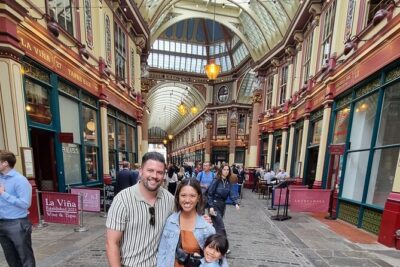
The Premier Classic London: Private 4-Hour Tour in a Black Cab
Read our review →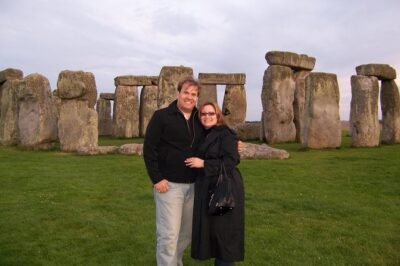
Stonehenge Inner Circle Private Tour from London with Bath Visit
Read our review →
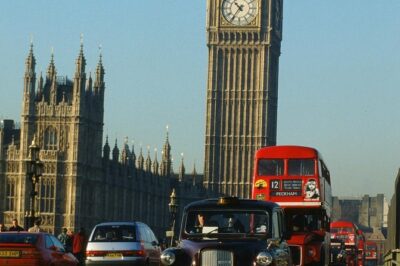

Private London Arrival Transfer – Airport to Hotel / Accommodation
Read our review →
Private 3-Hour Guided Beatles Classic Tour of Liverpool
Read our review →
British Museum London Guided Tour Semi-Private 8ppl Max
Read our review →