
Reviewed · CORNWALL TOURS
Half-Day Coasteering in Newquay Cornwall
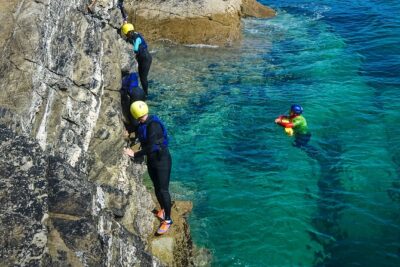
The best part of this Newquay outing is that you explore the Cornish coast from the water, not from a clifftop path. You swim through the edge of the sea, scramble over rock, and work up from small jumps to larger ledges. I like the expert lifeguard supervision and the way guides such as Nick, Tony, Paul, and Noah build confidence one step at a time.
I also like the practical value: a 5mm wetsuit is included, along with a helmet and, in winter, boots and gloves. Your GoPro photos and videos are included too, so you are not forced to choose between taking pictures and holding on to the rocks. The main drawback is that the sea controls the day. Rough water can shorten the active part of the session, and the changing facilities may feel basic.
Key points to know before booking
- The route begins near Fistral Beach: You meet at Newquay TR7 1HY, gear up, and walk a short distance to the coast.
- You need to swim 50 metres: Prior coasteering experience is not required, but you do need confidence in the water and good physical fitness.
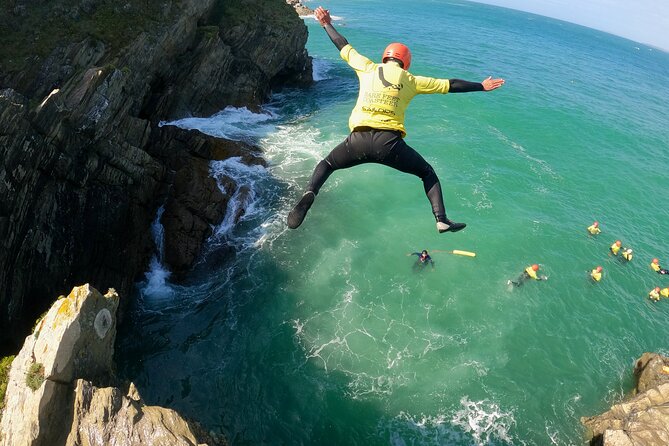
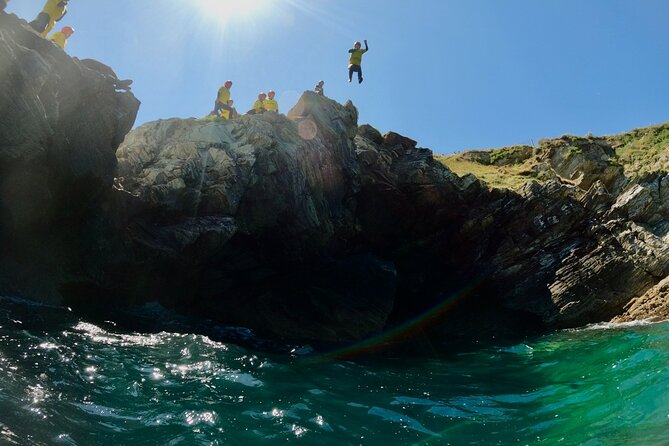
- The activity builds in stages: Expect swimming, climbing, and jumps that can progress toward a final jump of roughly 40 feet when conditions and group ability allow.
- Nick is a strong guide for nervous beginners: His calm instruction, humour, and encouragement help turn nerves into manageable challenges.
- Winter kit is warmer: The operator supplies a 5mm wetsuit year-round, with boots and gloves in winter. From May to November, bring your own trainers or wetsuit boots.
- The sea sets the schedule: Poor weather can lead to a new date or a refund, and rough water may change the route or reduce the time in the water.
Starting at Fistral Beach with the right expectations
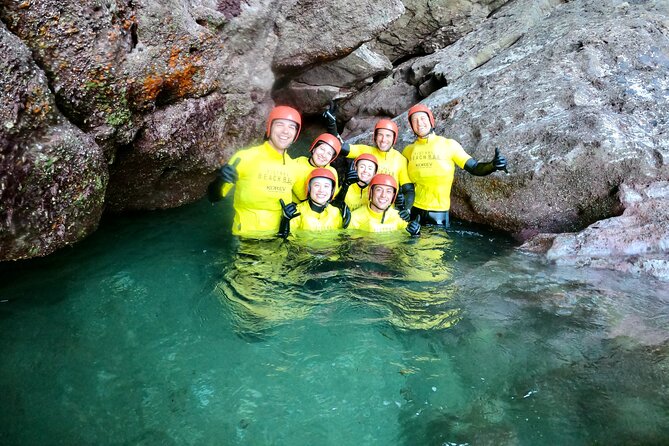
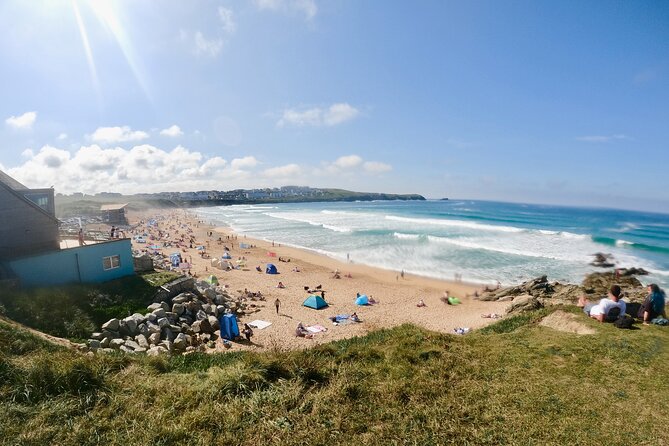
Bare Feet Coasteer operates from the Fistral Beach area of Newquay, one of the town’s best-known seaside spots. Your meeting point is Newquay TR7 1HY, and the session starts at 11:00 am. From there, you get fitted with equipment before walking a short distance to the route.
This is not a sightseeing trip where you sit back and watch the coast go by. You are the moving part of the scenery. The shore appears in pieces as you swim around rocks, climb onto ledges, and look for the next safe place to move. That makes the outing feel more like an active exploration than a standard beach activity.
The full session lasts about three hours, but not every minute is spent jumping or swimming. Time goes into changing, safety instruction, walking to the coast, and waiting for the group to move safely through each section. That is normal for an activity shaped by tides, waves, and mixed ability levels.
The company limits the group to 16 people. That is small enough for a guide to keep an eye on the group, though a full session can move more slowly than a private outing. If you are booking alone, contact the operator first. They do not run sessions for one person, but they can advise you about the nearest suitable group booking.
A few more Cornwall trips to weigh up
- Stonehenge Half-Day Tour from London with Admission
★ 4.0 · 1,207 reviews - Stonehenge Morning Half-Day Tour from London Including Admission
★ 5.0 · 634 reviews - Stonehenge Half-Day Tour from London with Admission
★ 4.5 · 306 reviews
Getting equipped for a Cornish sea session
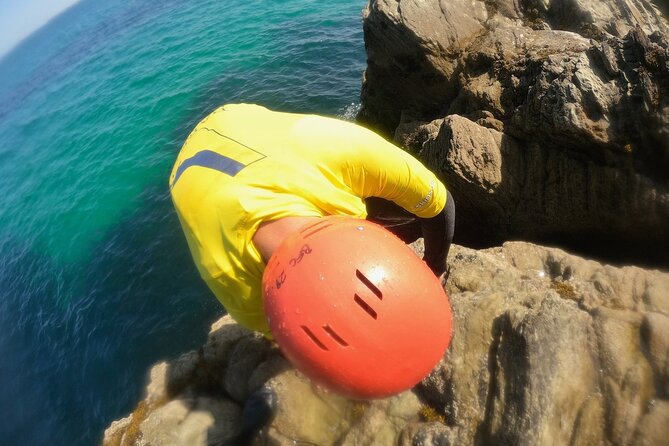
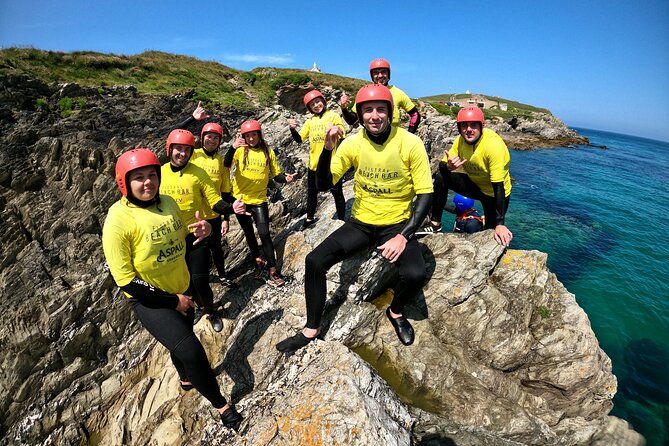
The supplied 5mm wetsuit is important, not just a nice extra. Even in warmer months, sea temperatures around Cornwall can make a long water session uncomfortable without proper insulation. The wetsuit also gives you some protection from contact with the water and rock, though you still need to move carefully.
A helmet is included for the whole activity. In winter, the equipment package also includes buoyancy boots and gloves, which make a real difference when your hands and feet are exposed to cold water. During the summer period from May through November, bring your own trainers or wetsuit boots, as those are not included then.
Wear something that you can change out of easily, and keep your expectations realistic about the base. The changing room has been described as neglected, with no toilets or showers available. That is the clearest practical weakness in the experience. You should not book this expecting a polished beach club with hot showers afterward.
The gear and safety kit matter more than fancy facilities here, and the equipment has generally been kept in good condition. Still, bring what you need to manage before and after the session. The information provided does not promise storage arrangements, towels, or shower access, so do not rely on those extras.
The first swim and the first safe jump
Once the group reaches the route, the session begins in the water. One account describes the opening move as a belly flop into the sea, followed by a swim toward smaller jumps. That gives you an immediate sense of the activity: you are not easing into it from a dry platform.
The guides explain how to jump safely before asking you to take on anything high. You learn to follow instructions, judge the landing area, and enter the water in a controlled way. The early sections are useful because they let you understand your wetsuit, buoyancy, and the movement of the sea before the bigger challenges arrive.
The guides do not need you to have coasteered before. You do need to be able to swim 50 metres and have a good level of physical fitness. You will be working with your arms and legs, climbing over uneven rock, and repeatedly getting in and out of the water. If swimming makes you anxious, this is not the right place to pretend you are comfortable.
A good guide also gives you permission to say no. The best accounts of the session describe no pressure to take a jump that feels beyond your limit. Nick is praised for being patient, funny, and encouraging, while also explaining what to do. That balance is valuable. You want a guide who helps you stretch, not one who treats fear as a failure.
Swimming, scrambling, and reading the rocks
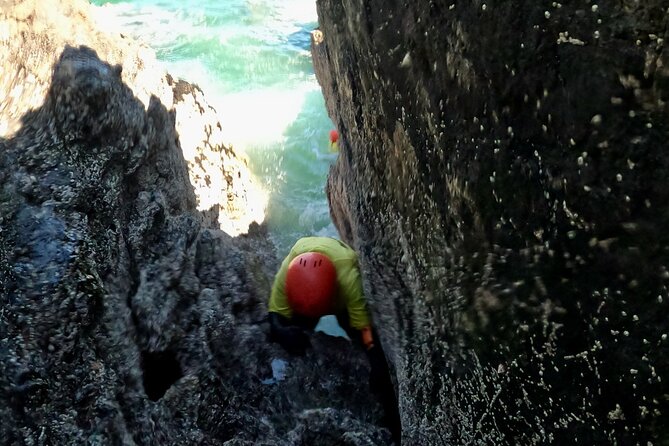
The central section links short swims with low climbs and jumps. You might move along a rock shelf, climb onto a ledge, and then enter the sea again. The route is not a single long swim or a series of isolated leaps. It is a chain of small decisions made in moving water.
Cornwall’s rocky coast is the main attraction, but you experience it at close range. From the water, a ledge is no longer just a shape on the horizon. It becomes a handhold, a place to sit, or the next point from which to enter the sea. You see the coast from angles that walkers cannot reach without getting wet.
Guides such as Nick and Tony also add local interest by sharing facts about the area as the group moves. The information supplied does not list a fixed set of topics, so you should expect informal commentary rather than a formal history lecture. The activity remains physical first.
The route can feel different from one session to another because the ocean affects access and safety. A calm day may allow the group to cover more of the planned course. Rough water can make even a short swim tiring, including for strong swimmers. One session was cut to around an hour and a half of coasteering because conditions became too difficult near the end.
That is not a reason to dismiss the activity, but it is a reason to book with some flexibility. You are paying for guided access to a natural setting, not a guaranteed number of jumps. The operator can cancel for poor weather and offer another date or a full refund. Once the session is under way, the guides must make the same call on which sections are safe.
Same country, a completely different day out:
- Doc Martin Tour in Port Isaac, Cornwall
★ 4.5 · 840 reviews - Coasteering Experience in Newquay
★ 5.0 · 465 reviews - Surf Lesson
★ 5.0 · 349 reviews - Falmouth Uncovered Walking Tour (Award Winning)
★ 5.0 · 267 reviews
Building from small ledges to the big finish
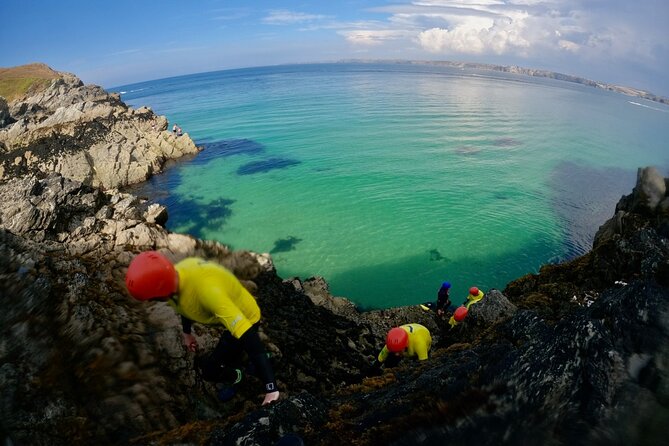
The jumps are usually introduced in stages. You start with smaller heights, learn the technique, and then decide if you want to move up. This progression is one of the strongest parts of the outing for families and first-timers because you can test your nerve without committing to the highest point at the start.
On a good route and suitable day, the group may reach a final jump of about 40 feet. That is a serious leap, not a compulsory finale. You should expect the guides to offer choices based on your comfort, the group’s ability, and the sea below.
The jump is only one part of the appeal. The climb to the ledge, the pause before entering the water, and the relief after resurfacing all form part of the experience. The GoPro footage is especially useful here. You receive photos and videos of the session, including the moments that are hard to capture from shore.
Do not assume the GoPro material will make every jump look enormous or cinematic. Its real value is simpler: you get a record of an activity where your hands are too busy for a phone. The included media also adds value to the $76.25 price, since you do not need to arrange a separate photographer or buy an image package afterward.
How the guides shape the day
The staff make a major difference. Nick is repeatedly singled out for being accommodating, charismatic, patient, and funny. He also explains interesting facts and helps people move from nerves to excitement. That is exactly the right mix for a group where one person may be eager for a 40-foot jump and another may be weighing up the first small ledge.
Tony, Paul, and Noah are also named as guides who provide clear help and encouragement. The strongest pattern is not wild showmanship. It is steady supervision, simple directions, and a willingness to let you choose your level.
The guides are qualified lifeguards, which matters because this is an activity in open water beside rocks. That qualification does not remove the need for you to follow instructions or judge your own ability, but it gives the group trained supervision during swims and jumps.
One particularly practical detail is that a guide carried an inhaler in a medicine bag for a participant with asthma. You should still tell the operator about any relevant medical issue before starting. The point is not that every need will be handled in the same way, but that the guides are expected to take safety concerns seriously.
Is $76.25 good value for three hours?
At $76.25 per person, this is not a cheap way to spend a morning at the beach. It is fair value if you use the main inclusions: a 5mm wetsuit, helmet, qualified lifeguard guides, training, the activity itself, and GoPro photos and videos.
You are also paying for route choice and safety management. Coasteering beside exposed rock is not something I would recommend attempting alone after watching a few online clips. A guide decides where to move, explains how to approach jumps, and changes the plan when the sea makes a section unsafe.
The value is strongest for families with active teenagers, couples seeking a shared challenge, and groups that want something more memorable than a standard surf lesson. It is less convincing if you mainly want a relaxed coastal view, a clean changing room, or a guaranteed three hours of continuous action.
Group size matters to value too. With a small group, the session may move quickly and leave more time for larger jumps. A full group of up to 16 can mean more waiting and less individual attention. That is not necessarily a problem, but it is worth bearing in mind when comparing prices.
Weather, timing, and the things you should pack
The operator runs the activity all year, though winter bookings are available only on weekends. Winter sessions include boots and gloves, which make cold-weather coasteering more practical. Summer sessions still require you to take the water seriously, since a wetsuit does not make you immune to cold.
Poor weather can cancel the experience. If that happens, you are offered another date or a full refund. The sea can also alter the route during a session, so avoid scheduling this immediately before an important departure or fixed evening plan.
The stated start time is 11:00 am, and the activity ends back at the meeting point. Allow the full three-hour window rather than planning another appointment too closely afterward. You should also allow extra time for changing before leaving Newquay.
Bring your own trainers or wetsuit boots from May through November. A helmet and wetsuit are supplied, with winter boots and gloves included. The available information does not confirm toilets, showers, towels, or a dedicated place for personal belongings, so plan around those gaps.
Confirmation normally arrives at booking. If you book within four hours of the start, confirmation comes as soon as possible and depends on availability. Free cancellation is available up to 24 hours before the start time. Inside that period, changes and refunds are not accepted.
Who should book this Newquay adventure?
You should consider it if you can swim 50 metres, have good physical fitness, and like the idea of making decisions in the moment. You do not need previous coasteering experience. A basic level of confidence is more useful than technical skill.
Families can get a lot from it, especially when teenagers want a real challenge and adults want trained supervision. The guides can encourage bigger jumps, but the experience does not require every person to take the same route. That flexibility makes it more suitable for mixed-confidence groups.
It also suits active friends who want a shared story from their time in Newquay. The climbs and jumps give the group a clear sense of progress, while the photos and videos preserve the parts you cannot easily describe later.
I would be cautious about booking if you dislike cold water, struggle with open-water swimming, or want a gentle activity. You should also think twice if basic facilities will bother you. This is a rugged coastal outing, and the rough-water possibility is part of the deal.
Should you book Bare Feet Coasteer?
Book it if your idea of seeing Newquay includes getting wet, climbing rock, and working toward a high jump under close supervision. The guides, warm equipment, included GoPro media, and flexible approach to different confidence levels make the $76.25 fee reasonable for an active three-hour session.
Do not book it for guaranteed conditions or luxury facilities. The sea may shorten the route, and the base may not offer the toilets or showers you expect. If you accept those limits, this is a memorable way to meet Cornwall’s coast at eye level, with enough structure to make a first coasteering experience feel manageable.
FAQ
Where does the coasteering session start?
The meeting point is in Newquay at TR7 1HY, near Fistral Beach. The group then walks a short distance to the coastal routes, and the activity ends back at the meeting point.
What time does the activity start?
The stated start time is 11:00 am.
How long does the experience last?
The session lasts approximately three hours, including preparation, safety training, walking to the route, and the coasteering itself.
Do I need previous coasteering experience?
No. Previous experience is not required, but you need some confidence and must be able to swim 50 metres.
What equipment is included?
A 5mm wetsuit and helmet are included. Buoyancy boots and gloves are also supplied during the winter months. From May through November, you are asked to bring your own trainers or wetsuit boots.
Are photos and videos included?
Yes. GoPro photos and videos from the session are included in the price.
Is the activity available in winter?
Yes. The operator runs the activity all year, but winter bookings are available only on weekends.
What happens if the weather is poor?
The experience may be canceled if the weather is unsuitable. You will then be offered a different date or a full refund. You can also cancel up to 24 hours before the start time for a full refund.
Just added around Cornwall
- The Falmouth Ghost Tour (Award Winning)★ 5.0 · 71 reviews
- Falmouth Tour App, Hidden Gems Game and Big Britain Quiz (1 Day Pass) UK★ 4.5 · 3 reviews
- Quoits, Stone circles and Monoliths on Bodmin Moor★ 5.0 · 4 reviews
- Taster Surfing Lesson in Bude★ 5.0 · 101 reviews
- Full Day Private Tour of West Cornwall★ 5.0 · 5 reviews
- West Cornwall Tour with Poldark Filming Locations★ 5.0 · 13 reviews
- Full Day Private Guided Tour of Poldark Filming Locations★ 5.0 · 3 reviews
- Private Tour of North Cornwall for Breathtakingly Rugged Coast★ 5.0 · 15 reviews
Cornwall Tours, compared.

Falmouth Uncovered Walking Tour (Award Winning)
Read our review →
Browse the lists this tour appears in