
Reviewed · CITY TOURS
Money and Power in the City Sightseeing Tour
London’s financial district is far older and stranger than its glass towers suggest. On this two-hour walk, you follow the trail from Roman and medieval beginnings to the East India Company, the first stock-market coffeehouse, the Royal Exchange, and the modern market beneath St Paul’s Cathedral. Money and power are the real subjects, with gossip and scandal helping the facts stick.
I like the small maximum of eight people, which gives guide Terry room to answer questions and adjust his explanations for the group. I also like the walk’s clear time span: you move from Roman London to current finance without being trapped inside a museum. The possible drawback is that this is an outdoor history walk, so poor weather can lead to cancellation, and the tour does not include entry to the major buildings.
Key points at a glance
- Roman beginnings to modern finance: The tour connects the City’s earliest foundations with its role as a global financial center.
- A group capped at eight: The small size makes questions easier and gives the guide a more personal setting.
- Terry brings the story to life: His approach combines political and financial history with humor, gossip, and scandal.
- Historic sites come one after another: You see the Royal Exchange, Bank of England, Mansion House, Guildhall, Exchange Alley, and St Paul’s Cathedral.
- A useful first-day orientation: The tour can help you understand London soon after arriving from abroad.
- Good value for a walking tour: At $41.14 per person, you pay for interpretation and context rather than admission tickets.
Why London’s City is the right place for this story
The City of London is compact, but its story reaches across centuries. Roman settlement, medieval guilds, imperial trade, banking, and modern stock dealing all meet within a short walk. That makes this tour useful if you want more than a quick look at impressive buildings.
You are not simply moving from one landmark to another. The guide explains how power gathered in this part of London and how commercial institutions shaped the streets around them. A grand building becomes easier to understand when you know what it was built to do, who used it, and what kind of influence it carried.
The title, Money and Power in the City, is a fair description of the route. The focus is not only on finance. Political influence, overseas trade, royal connections, civic institutions, and the social life of merchants all form part of the story.
That broad approach suits you if London’s past feels like a jumble of kings, companies, churches, and financial firms. Terry’s job is to put those pieces in order. The strongest praise for the tour centers on his ability to explain complex subjects clearly, with humor and a lively supply of anecdotes.
A few more London trips to weigh up
- City Sightseeing London Hop-On Hop-Off Bus Tour & Bookable Extras
★ 4.0 · 1,224 reviews - Eating London: The Heart of ‘The City’ Food Tour
★ 5.0 · 206 reviews - London Luxury Dinner Experience with Panoramic City Views
★ 4.5 · 174 reviews
Starting with Roman and medieval London
The opening section covers the Roman and medieval beginnings of the financial district. This is important because the City’s present role did not appear out of nowhere. The streets you see today grew from a much older center of trade, administration, worship, and civic life.
You get a foundation for everything that follows. Before looking at markets and banks, you learn why this particular part of London became so important. That early context also helps you see the City as more than a business quarter filled with offices.
The medieval period brings another key idea: organized trade depended on institutions. Guilds helped regulate crafts and commerce, while halls gave members places to meet, store goods, and hold celebrations. The tour uses these details to show how business and community life were closely linked.
I would pay close attention here, even if your main interest is modern London. The later stops make more sense once you understand that the City’s power grew through long-running systems of trade, membership, rules, and privilege.
The East India Company and the reach of trade
One stop focuses on the most important historic location connected with the East India Company, after the walk has already pointed out other related sites. This gives the company a place within a larger City story rather than treating it as an isolated curiosity.
The East India Company is a strong example of how commerce could carry political force. Its story links a London business institution with overseas trade and the wider growth of British influence. The tour uses the physical places in the City to make that history easier to picture.
You should expect interpretation rather than a visit inside a dedicated exhibition. The value is in seeing the location and hearing why it mattered. Terry’s style, according to the material available about the experience, includes stories and scandal alongside formal history. That mix can make a difficult subject easier to follow.
This part is especially useful if you want to understand how the City’s financial power reached well beyond London’s streets. It also adds moral and political weight to what might otherwise seem like a simple story of successful business.
The Royal Exchange, Bank of England, and Mansion House
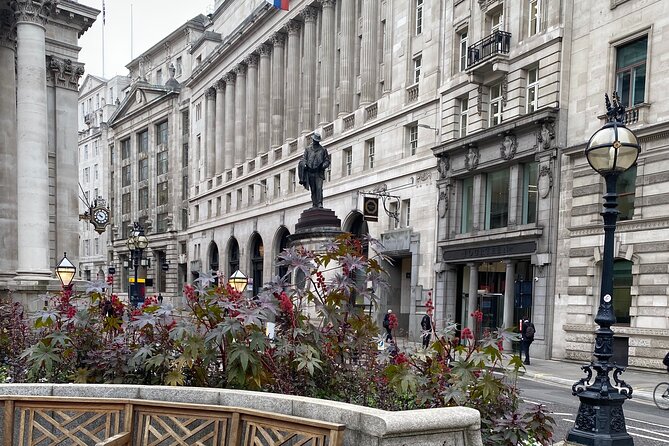
The walk then reaches three of the City’s most important grand buildings: the Royal Exchange, the Bank of England, and Mansion House. Their neo-classical design gives you a visual break from the narrow lanes and older structures nearby.
These buildings also represent different kinds of authority. The Royal Exchange points to organized commerce. The Bank of England represents monetary power and national finance. Mansion House connects the City with civic leadership and public office.
The pleasure here comes from combining architecture with purpose. Instead of only admiring columns and façades, you learn how these institutions helped shape London’s commercial life. The setting also shows how the City used monumental buildings to project order, confidence, and importance.
A practical note: the tour is built around seeing these places from the outside. The supplied details do not promise interior access, so book this walk for explanation and street-level views, not for tours of the Bank of England or Mansion House.
Same country, a completely different day out:
- Stonehenge, Windsor Castle, and Bath from London
★ 4.5 · 18,662 reviews - London Big Bus Hop-On Hop-Off Tour with Optional River Cruise
★ 3.5 · 10,803 reviews - London Small Group Tour of Historical Pubs
★ 5.0 · 10,422 reviews - Stonehenge, Windsor Castle and Bath with Pub Lunch in Lacock
★ 4.5 · 7,402 reviews
Exchange Alley and the coffeehouse birth of the stock market
Exchange Alley, also called Change Alley, is one of the route’s most interesting details. This narrow passage links Cornhill and Lombard Street, and it once offered a handy shortcut between the Royal Exchange and the Post Office.
The alley matters because it helps you picture how business was conducted before today’s trading screens and formal financial floors. The tour points out the location of the coffee shop where the stock market was first based. That small-scale setting gives the City’s financial story a human shape.
Coffeehouses were places where people met, exchanged news, made connections, and conducted business. The exact atmosphere of modern finance can be hard to imagine when you are looking at a large office tower. A narrow alley and a former coffeehouse location bring the story down to street level.
I particularly like this stop for that reason. It is a reminder that major institutions often begin in ordinary places. You may walk through Exchange Alley without noticing it on your own, but with context it becomes one of the most memorable parts of the route.
Guildhall and the medieval guild buildings
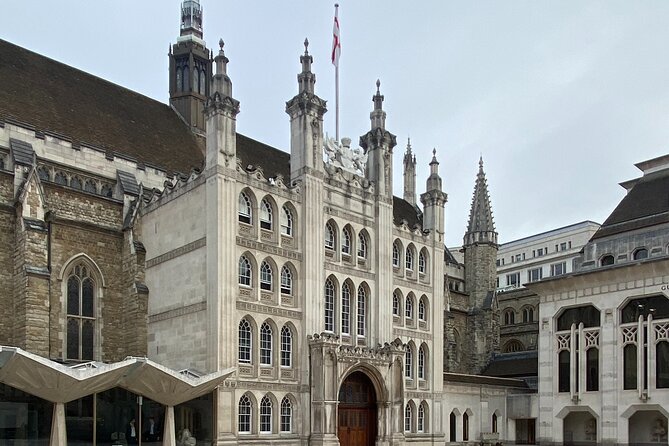
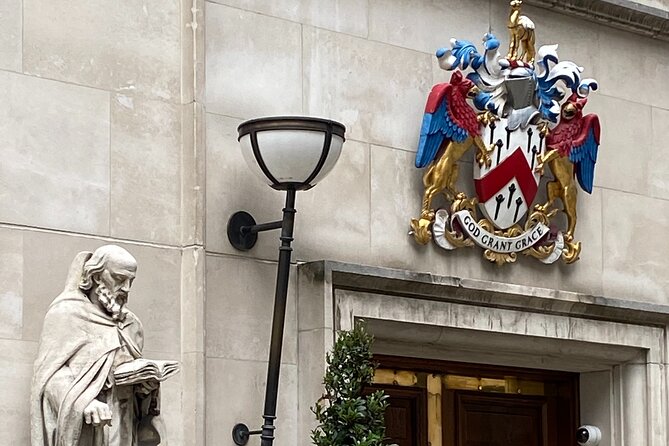
Guildhall offers another change in tone. This medieval hall was used by guild members to store goods and hold celebrations. When guild events were not taking place, it could also host entertainments for townspeople, including Passion plays.
That detail makes medieval London feel social rather than purely institutional. The hall was tied to business, but it was also part of public life. The nearby guild buildings add to the picture, showing how trade organizations helped define the City’s identity.
The guide selects Guildhall and nearby guild buildings rather than trying to cover every historic site in the district. That is a sensible choice within a two-hour walk. You get a focused look at how guilds operated and why their buildings still matter.
This stop should appeal to you if you prefer places with several layers of use. Guildhall was not only a handsome old structure. It held goods, hosted ceremonies, supported professional groups, and provided space for public entertainment.
Modern markets beneath St Paul’s Cathedral
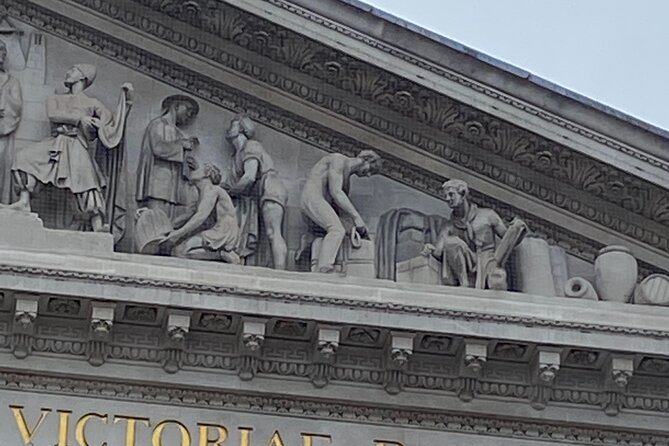
The final section brings you to the modern stock market, with St Paul’s Cathedral rising above it. The contrast is powerful: contemporary finance below, one of London’s great Anglican landmarks nearby, and centuries of City history between them.
St Paul’s sits on Ludgate Hill, the highest point in the City, and serves as the mother church of the Diocese of London. Even if you have already seen the cathedral elsewhere, this viewpoint gives it a different role. It becomes part of the story of authority, public life, and changing London.
Ending at the London Stock Exchange in Paternoster Square gives the walk a clear present-day finish. You have moved from Roman foundations, medieval guilds, and early commerce to the institutions associated with modern markets.
The endpoint is at 10 Paternoster Square, by the main column. This makes the finish easy to identify. It also leaves you near one of London’s best-known sights, though the experience itself does not include cathedral admission.
What Terry’s guiding style adds
The guide is Terry, also referred to in the supplied information as Mr. Silvers. His strongest asset is explanation. He presents financial and political subjects in a way that can work for people with no background in economics or London history.
That matters because the City can feel hard to read. You may recognize the Bank of England or St Paul’s, yet still have no idea how the institutions around them connect. Terry provides that missing structure, linking early London with present-day effects.
The tone is not meant to be a dry lecture. Stories, gossip, humor, and scandal form part of the experience. That approach will suit you if you remember people and surprising incidents more easily than dates and institutional names.
The small group also helps. With no more than eight participants, you should have a better chance to ask about a building, clarify a term, or pursue a subject that interests you. It is a more personal format than a large city walk, though the experience still depends on the guide’s pace and the group’s questions.
Is $41.14 good value?
At $41.14 per person, this is not the cheapest way to spend two hours in central London. You can walk through the City on your own for nothing. The question is what you gain by joining the tour.
The answer is context. You are paying for a route that connects scattered places and for a guide who explains why they belong together. The Royal Exchange, Exchange Alley, Guildhall, and St Paul’s are more meaningful when you understand their links to commerce, civic life, and power.
The price also includes the benefit of a very small group. If Terry’s explanations help you see London with more understanding for the rest of your visit, the cost can be reasonable, especially for a first visit.
You should not expect entrance tickets, food, transport, or a full-day sightseeing program. This is a focused walking experience. If you want interiors or a longer tour, you will need to plan those separately.
Who should book this City of London walk?
I would recommend it to you if you enjoy history but want it tied to real streets and buildings. It also suits anyone curious about how finance, politics, overseas trade, religion, and civic institutions shaped London.
It is a particularly useful choice soon after arriving in the city. One strong account describes the walk as helpful for understanding London after arriving from the United States. That makes sense: the tour gives you a framework that can make later sightseeing more rewarding.
Families can also find a good fit here. The guide’s explanations are designed to meet people at different levels of prior knowledge, and the storytelling approach should work better than a highly technical finance talk.
You may want to skip it if your main goal is interior access, shopping, or a relaxed ride with little walking. You should also think twice if wet weather would spoil your day, since good weather is required and poor conditions may lead to a new date or a full refund.
The tour begins at 2:00 pm near Emperor Trajan, at A100, London EC3N 4DR. It ends at Paternoster Square, so check the starting and finishing points carefully when fitting it into your day. The route is near public transport, service animals are allowed, and most people can participate.
Free cancellation is available if you cancel at least 24 hours before the local start time. Changes or cancellations inside that window are not accepted for a refund.
Should you book Money and Power in the City?
Book this tour if you want London explained through its places of business and power, not only through royal palaces and famous churches. The route has a strong arc, moving from Roman beginnings to medieval guilds, imperial trade, early stock dealing, major financial institutions, and the modern market.
The best reasons to book are Terry’s clear storytelling, the group limit of eight, and the unusual details around Exchange Alley and the old coffeehouse. At $41.14, it is fair value when you want insight rather than admission tickets.
Skip it if you dislike walking, need guaranteed indoor activities, or want a tour focused mainly on St Paul’s Cathedral. For anyone curious about how money and power shaped London, this is a compact and useful two-hour introduction.
FAQ
How long does Money and Power in the City last?
The tour lasts approximately two hours.
What time does the tour begin?
It begins at 2:00 pm.
Where does the tour start?
The starting point is Emperor Trajan, A100, London EC3N 4DR, UK.
Where does the tour finish?
The tour ends at the London Stock Exchange, 10 Paternoster Square, London EC4M 7LS, by the main column.
What language is the tour offered in?
The tour is offered in English.
How many people can join the tour?
The maximum group size is eight people.
Does the tour include mobile tickets?
Yes, a mobile ticket is provided.
What landmarks are included on the walk?
The route includes Roman and medieval City history, East India Company sites, the Royal Exchange, Bank of England, Mansion House, Exchange Alley, Guildhall and nearby guild buildings, the modern stock market, and views of St Paul’s Cathedral.
Are service animals allowed?
Yes, service animals are allowed.
Can I cancel for a full refund?
Yes, if you cancel at least 24 hours before the experience start time. Cancellations made less than 24 hours before the start are not refunded.
What happens if bad weather cancels the tour?
You will be offered a different date or a full refund if the experience is canceled because of poor weather.
Just added around London
- Private The Beatles Taxi Tour in London★ 5.0 · 12 reviews
- Dinner and Jazz Cruise on the River Thames★ 4.0 · 140 reviews
- Airport Coach Service from Heathrow to Oxford★ 3.5 · 67 reviews
- The Alfred Hitchcock London Walk with Sandra Shevey★ 5.0 · 15 reviews
- Tower of London & 30+ London Sights Walking Tour★ 4.5 · 33 reviews
- Thames Beachcombing★ 4.5 · 100 reviews
- Ted Lasso Tour of Richmond with Private Guide★ 5.0 · 25 reviews
- Ted Lasso Tour of Richmond★ 5.0 · 152 reviews
City Tours, compared.


Liverpool City Sights Hop On Hop Off City Tour – 24hr Ticket
Read our review →
1.5-hour Oxford City and University Walking Tour
Read our review →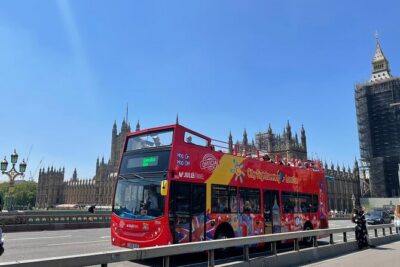
City Sightseeing London Hop-On Hop-Off Bus Tour & Bookable Extras
Read our review →
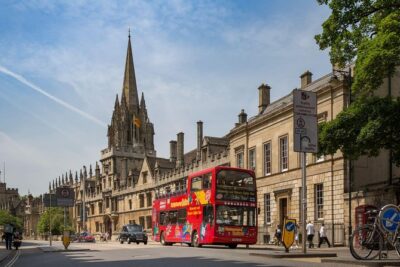
City Sightseeing Oxford Hop-On Hop-Off Bus Tour
Read our review →
Browse the lists this tour appears in