

Reviewed · STRATFORD UPON AVON TOURS
Shakespeare’s Schoolroom & Guildhall Entry Ticket and Tour
Young William Shakespeare studied Latin in this very room in the 1570s. That simple fact gives this visit its spark: you are not just looking at a portrait or reading a plaque. You can sit in the old classroom, handle a quill, and hear Master Jenkins turn Tudor schoolwork into a lively lesson.
I like the hands-on Tudor activities, especially writing with ink and dressing up for a photo. I also like the chance to see the Council Chamber where Shakespeare’s father served as Bailiff, or mayor, and where the young Shakespeare may have watched visiting actors perform. The main drawback is pace: the schoolroom can feel hurried when school groups arrive, and the first part may hold less interest for younger children than the lesson upstairs.
Key points to know before you go

- Study in Shakespeare’s actual schoolroom: Sit where William Shakespeare was educated during the 1570s.
- Meet the Tudor schoolmaster: Master Jenkins leads a playful lesson with Latin, discipline, and period detail.
- Try quill and ink: You get to write in the old-fashioned way, with all the mess that implies.
- See Stratford’s medieval civic center: The Guildhall dates from 1420 and includes the Council Chamber.
- Hear family connections: Shakespeare’s father served as Bailiff, or mayor, in the building.
- Plan for a small, lively visit: Entry is about $18.02, with opening hours from 11 a.m. to 4:30 p.m. daily.
Why this small Stratford visit feels personal

Stratford-upon-Avon has no shortage of Shakespeare sights. Some focus on the famous playwright as an adult. This one takes you back to the boy before the plays, when school meant Latin grammar, strict lessons, and a feather pen that refused to behave.
The setting does much of the work. The building began in 1420 and is one of the few medieval Guildhalls still surviving in England. You move through rooms that served both education and civic life, so the visit connects Shakespeare’s childhood to the town around him.
I especially like that the building is not treated as a silent shell. Films explain the school and the Guildhall, while guides bring out the links between Stratford’s public life and the Shakespeare family. That combination keeps the visit from becoming a quick look at an old room.
The attraction is modest in size. That is good news if you want a focused stop rather than a half-day museum. It also means the visit depends heavily on the staff and the timing of your arrival. When a school group fills the room, the atmosphere can become lively and the staff may have less time for each person.
A few more England trips to weigh up
- Tower of London and Crown Jewels Exhibition Ticket
★ 4.5 · 6,677 reviews - Thorpe Park Admission Ticket
★ 4.0 · 5,915 reviews - Alton Towers Resort 1 Day Admission Ticket
★ 3.5 · 5,501 reviews
Starting with the Guildhall and its civic story
Your visit begins at Shakespeare’s Schoolroom and Guildhall, where films provide background on Shakespeare’s school days and the building’s role in Stratford. This opening section gives you useful context before the classroom activity begins.
The Guildhall was not built only for lessons. It played a part in the town’s civic life for centuries. The Council Chamber is particularly important because John Shakespeare, William’s father, served as Bailiff there. In modern terms, he held the town’s highest civic office, so the family connection reaches beyond the famous son.
You also see the room where Shakespeare first witnessed performances by some of England’s leading actors. That detail gives the building a direct link to his later career. It is not proof that one visit created a playwright, but it helps you picture the young Shakespeare encountering theater in a familiar town setting.
The first section may appeal most to adults and older children who enjoy context. One family found that younger children were less engaged at the start and preferred the schoolmaster portion. If you are visiting with children, you may want to ask staff how the timing works that day and keep expectations flexible.
Sitting where Shakespeare studied in the 1570s

The schoolroom is the heart of the visit. You sit in the classroom where Shakespeare is understood to have studied in the 1570s, when Latin formed a major part of a boy’s education.
The lesson gives you a taste of that school life rather than a long academic lecture. You may brush up on Latin, take part in Tudor games, and learn how a pupil might have worked with a quill and ink. The point is not to master the language. It is to feel the difference between Tudor schooling and a modern classroom.
Master Jenkins receives especially strong praise for making this portion funny and easy to follow. His role as the schoolmaster adds a bit of theater, but the lesson also carries real information about the period. You might be corrected for poor behavior, called to account by the teacher, or encouraged to answer questions as a Tudor pupil would.
That playful approach works for adults too. You do not need to be a Shakespeare specialist. Several visitors arrived with little idea of what to expect and found the school lesson became the highlight of their time in Stratford.
Quill writing, Latin, and Tudor games
The quill activity is the most memorable part for many people. You can dip a feather pen into ink and try writing for yourself. It sounds simple, but keeping the ink under control takes care. Expect an activity rather than a polished souvenir.
This is also where the visit becomes useful for families. Children can connect an old object with an actual task. A quill is no longer something seen behind glass. It becomes a tool that splutters, scratches, and demands patience.
The Tudor lesson may also include Latin practice and games. These details help you picture school as a demanding part of daily life, rather than a romantic scene from a costume drama. The schoolmaster’s manner adds humor, and the staff can answer questions as you move through the building.
One practical point: you may have only a short time with the quill when the attraction is busy. One person felt hurried out of the schoolroom after getting a chance to write. I would treat the activity as a brief taste, not a long workshop. If writing with ink matters to you, arrive when the building is quieter if your schedule allows.
Same country, a completely different day out:
- Stonehenge, Windsor Castle, and Bath from London
★ 4.5 · 18,662 reviews - London Big Bus Hop-On Hop-Off Tour with Optional River Cruise
★ 3.5 · 10,803 reviews - London Small Group Tour of Historical Pubs
★ 5.0 · 10,422 reviews - Beatles Magical Mystery Tour
★ 5.0 · 9,266 reviews
Tudor dress and the selfie moment
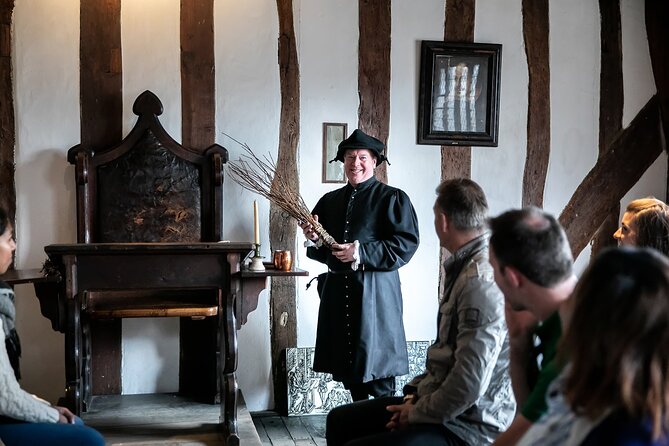
You can put on Tudor-style clothing and pose for a photo in the schoolroom. It is a lighthearted feature, but it serves a purpose. Period clothing helps children and adults picture the social world of the room, and it gives families a simple way to remember the visit.
This is not a full costume program, and you should not expect an elaborate theatrical production. The attraction works best when you join in. Try the clothes, answer the schoolmaster’s questions, and pick up the quill. If you only watch from the side, the visit may feel smaller than its price suggests.
The dress-up activity also breaks up the historical explanation. After hearing about the Guildhall and Shakespeare’s family, you get something physical to do. That change of pace helps younger visitors stay involved, even if the opening films and civic story do not immediately grab them.
Regina, Master Jenkins, and the value of live guides
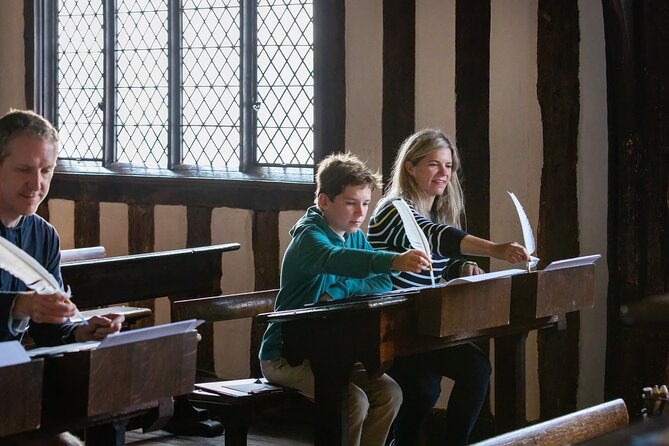
The guides make a major difference here. Regina is praised for combining facts about Shakespeare’s period with small details that are easy to miss if you walk through alone. Master Jenkins handles the schoolroom role, teaching Latin, explaining school life, and adding humor.
I would place a high value on that human element. The building itself is old and atmospheric, but a room does not explain its own purpose. A guide can point out why the Council Chamber matters, describe the Shakespeare family’s connection, and make the lesson feel like an event rather than a display.
The staff are also willing to answer questions. That matters if you have already read about Shakespeare and want more than the basic biography. The visit can add background about the era and the town that is not always obvious from the plays.
The quality of the presentation can vary with the crowd and with your own expectations. Most people will find the guides friendly and well prepared, but one particularly negative assessment found the tour unengaging and left early. That is a useful reminder that this is a live presentation. If you prefer quiet, self-guided exhibits, the theatrical schoolmaster approach may not suit you.
The medieval Guildhall beyond Shakespeare

It would be easy to focus only on the famous name and overlook the building. Try not to. The Guildhall is one of the few remaining medieval Guildhalls in the country, and its civic role gives the visit substance.
The Council Chamber shows how local government operated in Shakespeare’s time. His father’s position as Bailiff links the family to town administration, not just to the later literary world. This makes the visit useful for anyone interested in English civic history as well as Shakespeare.
Medieval wall paintings add another layer. You can see remnants of decoration that remind you this was a working building, not a museum created for modern visitors. The paintings, old rooms, films, and guide commentary create a compact picture of Stratford over time.
I would not compare the Guildhall with a huge national museum. There are fewer rooms and fewer objects. The reward comes from the direct connection between place, family, school, and town government.
How long to allow and when it works best

The advertised visit takes about 30 minutes to an hour. That is a sensible estimate for the building, films, guide interaction, and Tudor lesson. Some people spend longer when the lesson develops or when they take time with the displays.
The experience can also stretch toward two hours if you linger, wait through activities, or arrive during a busy period. Do not schedule it as a rushed ten-minute stop between major Stratford sights. You want enough time to listen, try the quill, and see the Council Chamber without checking the clock.
Opening hours are 11 a.m. to 4:30 p.m. daily during the stated operating periods. Those hours give you useful flexibility, but the visit is not an early-morning attraction. Check the date on your booking and plan around the daily schedule.
The building is near public transportation, and most people can take part. Service animals are allowed. Children must be accompanied by an adult, which is worth remembering if you are arranging a family visit with several young people.
Is $18.02 good value?
At about $18.02 per person, this is not the cheapest quick stop in Stratford, but it offers more than simple entry. Your ticket includes the guide and the Tudor lesson, along with access to the schoolroom, Guildhall spaces, films, wall paintings, and interactive activities.
I think the price works best for you if you take part. The value drops if you skip the lesson, avoid the dress-up activity, or leave before the schoolroom portion. Adults who enjoy local history should find enough context to justify the cost, while families gain from the hands-on elements.
The attraction also works well as a compact addition to a day centered on Shakespeare. You do not need to devote half a day to it, and the experience gives you a more grounded sense of his early life than a general town walk might provide.
Free cancellation is available when you cancel at least 24 hours before the start time. Changes or cancellations made later are not accepted for a refund, and the cut-off follows local time.
Who should book this experience?
I would recommend it most strongly to families with school-age children, Shakespeare fans, and anyone who likes historic buildings explained by a live guide. The quill, costume, games, and schoolmaster lesson give children something to do, while the Council Chamber and civic story give adults a reason to pay attention.
It also suits you if you have studied Shakespeare’s plays and want background on the man before the fame. Regina and Master Jenkins can add period details that do not come from reading the plays alone.
You may want to skip it if you dislike audience participation, costume activities, or short theatrical lessons. It is also less ideal if you want a large museum with extensive objects and long, quiet galleries.
Final verdict: book it for the schoolroom, not just the name
Book this visit if you want to sit in Shakespeare’s classroom, try Tudor schoolwork, and connect his family to Stratford’s civic life. The strongest parts are the live teaching by Master Jenkins, the friendly guide work from people such as Regina, and the chance to write with quill and ink.
Go at a relaxed pace and take part. The building is small, and busy school groups can make the visit feel hurried. But at around $18, it offers a direct, memorable encounter with Shakespeare’s early world, with enough history to satisfy adults and enough activity to keep children involved.
FAQ
Where does the experience take place?
It takes place at Shakespeare’s Schoolroom and Guildhall in Stratford-upon-Avon, England.
How long does the visit last?
The visit lasts approximately 30 minutes to one hour. Some sessions may take longer if you spend more time with the lesson and activities.
What activities are included?
You can take part in a Tudor lesson, practice some Latin, write with a quill and ink, play Tudor games, and dress in Tudor-style clothing for a photo.
Can children take part?
Yes. Most people can participate, and the activities are suitable for children. Children must be accompanied by an adult.
Is the attraction open every day?
Yes. The stated opening hours are 11 a.m. to 4:30 p.m., Monday through Sunday, during the listed operating periods.
Can I cancel for a refund?
Yes. You can cancel at least 24 hours before the experience start time for a full refund. Cancellations or changes made less than 24 hours before the start time are not accepted for a refund.
Just added around England
- Private The Beatles Taxi Tour in London★ 5.0 · 12 reviews
- Dinner and Jazz Cruise on the River Thames★ 4.0 · 140 reviews
- Airport Coach Service from Heathrow to Oxford★ 3.5 · 67 reviews
- The Alfred Hitchcock London Walk with Sandra Shevey★ 5.0 · 15 reviews
- Tower of London & 30+ London Sights Walking Tour★ 4.5 · 33 reviews
- Thames Beachcombing★ 4.5 · 100 reviews
- Ted Lasso London Taxi Tour★ 5.0 · 5 reviews
- Ted Lasso Tour of Richmond with Private Guide★ 5.0 · 25 reviews
Stratford upon Avon Tours, compared.

Cotswolds in a Day Tour from Moreton-in-Marsh / Stratford-on-Avon
Read our review →

The WalkTalkShow.co.uk – Guided Tour of Stratford upon Avon
Read our review →
The Sinister Side of Shakespeare’s Stratford Walking Tour
Read our review →
City Sightseeing Stratford-upon-Avon Hop-On Hop-Off Bus Tour
Read our review →Browse the lists this tour appears in