Reviewed · WALKING TOURS
Walking Tours – Sights of London- price includes upto 10 people
London’s literary story comes alive in the City, where a medieval monastery, Shakespeare’s London, grand civic buildings, and Roman remains sit within a short walking route. The most intriguing thread is the link between writers and places you might otherwise pass without a second look, especially around Blackfriars and Shakespeare’s playhouse.
I like two things here: the private format gives your group room to ask questions, and guide Sam brings a literature background from Cambridge University. I also like the mix of famous sights and less obvious details, from Chaucer and Wordsworth to T.S. Eliot and the old City lanes.
The main consideration is timing. Two hours passes quickly, and the stops are brief, with about five minutes listed at each major point. You get a lively introduction rather than a long visit inside each attraction, and no private transport or bottled water is included.
Key things to know before you book
- Shakespeare is the opening star: Blackfriars connects the walk to Shakespeare’s home, his playhouse, and several City locations tied to his work.
- Sam leads the walk: He is described as a Cambridge University literature graduate who combines facts, stories, wit, and time for questions.
- Five major City stops fit into two hours: The route covers Blackfriars, St. Paul’s Cathedral, the Bank of England, Mansion House, and Guildhall.
- The group is private: The $388.19 price covers up to 10 people, so the value improves sharply when shared by a full group.
- The focus is literary and historical: Chaucer, Wordsworth, T.S. Eliot, and Shakespeare help frame the City beyond its modern financial identity.
- The start is early: Meet at the City of London Information Centre beside St. Paul’s Churchyard at 7:00 am.
A literary walk through London’s oldest working district
The City of London can feel like a place built for office workers, banks, and hurried commuters. This walk gives you a different way to read it. Instead of seeing only offices and traffic, you begin noticing the writers, churches, civic buildings, and older layers beneath the modern streets.
The route is compact, but its subject is broad. You move from medieval religious life to Shakespearean theatre, then to the cathedral, the central bank, the Lord Mayor’s residence, and the ancient civic center at Guildhall. That range helps you see how literature grew out of London’s institutions, streets, commerce, religion, and public life.
Sam’s role matters here. A guide with a literature degree can do more than point out buildings. He can connect a place to the writers who used, described, or lived around it. His style, based on the information provided, is conversational and open to questions rather than a one-way lecture.
The walk has also proved useful for people who already know London. Sam has led walks for locals who pass these buildings regularly but had never heard the stories behind them. That is a good sign for repeat London visitors, commuters, and anyone who wants familiar streets to feel less familiar.
A few more London trips to weigh up
- Tour for Muggles The Ultimate Harry Potter Walking Tour in London
★ 5.0 · 4,684 reviews - London Jack The Ripper Guided Walking Tour
★ 5.0 · 3,131 reviews - Changing of the Guard Guided Walking Tour in London
★ 5.0 · 1,793 reviews
Blackfriars and Shakespeare’s City

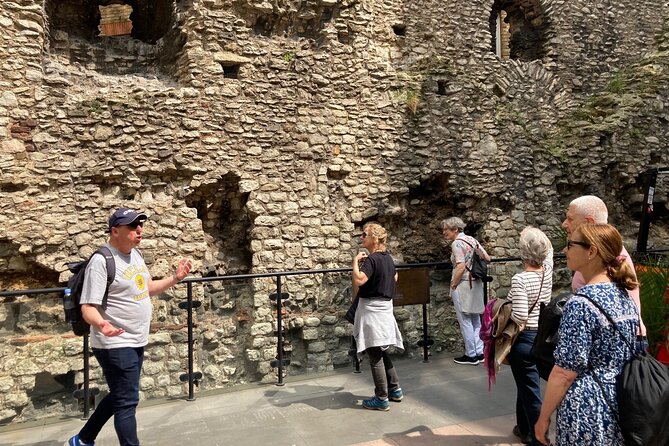
Blackfriars is the natural first stop for a tour centered on writers. Here, you look at remains of the 13th-century monastery and examine the area’s connections to Shakespeare. The stop includes the place where his playhouse was located, as well as where Shakespeare lived.
This is not presented as a full theatre visit or an indoor museum experience. It is a street-level history lesson, using the City itself as the setting. You discuss Shakespeare’s plays and other locations in London linked to him, which gives the writer a physical setting rather than leaving him as a name in a textbook.
I like this beginning because it puts literary history in a real urban frame. Shakespeare’s world was not an abstract period of poetry and drama. It was a city of monasteries, theatres, homes, churches, trade, and crowded public life. Blackfriars helps set up that idea quickly.
The listed time is about five minutes, so you should expect focused commentary rather than a long pause. If Shakespeare is your main reason for booking, pay close attention here and ask questions while the subject is fresh. The value comes from Sam’s explanation and the location, not from a long formal admission.
St. Paul’s Cathedral and the shape of London
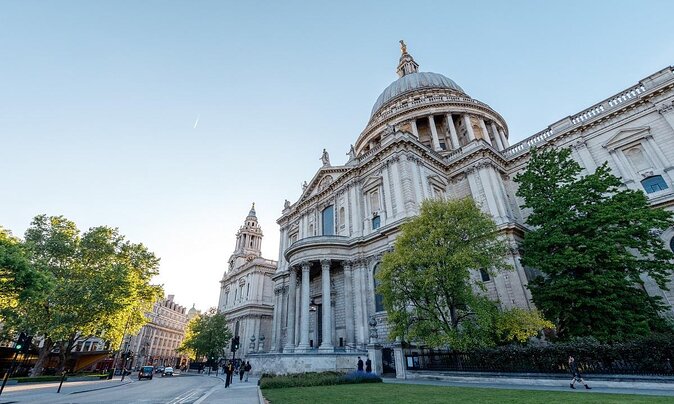
The next stop is St. Paul’s Cathedral, where you look at the building’s Baroque architecture and its place in London’s story. The cathedral is one of the City’s great visual anchors, so even a short explanation can help you understand how it fits into the surrounding streets.
The supplied details do not promise entry into the cathedral, and admission is listed as free for the stop. Plan on seeing and discussing the exterior and its setting rather than treating this walk as a cathedral interior tour. If you want to explore the inside, you would need to arrange that separately.
The short stop works best as part of the larger route. St. Paul’s brings religion, architecture, rebuilding, and civic identity into the conversation. After Blackfriars and Shakespeare, the cathedral widens the story from one writer to the city that shaped generations of London life.
An early start can help here. Meeting at 7:00 am means you begin before the day reaches its busiest pace. The experience is still weather-dependent, of course, and you should wear shoes suited to two hours on foot.
The Bank of England and London’s money story
At the Bank of England, the focus shifts from literature and religion to finance. You see the central bank of the United Kingdom and discuss its history and role in today’s economy.
That change of subject is useful rather than distracting. Writers such as Chaucer, Shakespeare, Wordsworth, and T.S. Eliot did not exist apart from London’s economic life. The City’s money, institutions, markets, and social structure helped shape the world they observed and wrote about.
Again, the stop is brief, about five minutes. You are not signing up for a museum visit or a detailed economics lecture. Instead, you get a clear introduction to why the Bank of England matters and how this part of London became associated with national finance.
This section may appeal most to visitors who want more than literary name-dropping. It gives the walk a practical civic angle. You see how the City functions today while learning how its older institutions helped form the setting for London’s writers.
Same country, a completely different day out:
- Stonehenge, Windsor Castle, and Bath from London
★ 4.5 · 18,662 reviews - London Big Bus Hop-On Hop-Off Tour with Optional River Cruise
★ 3.5 · 10,803 reviews - London Small Group Tour of Historical Pubs
★ 5.0 · 10,422 reviews - Stonehenge, Windsor Castle and Bath with Pub Lunch in Lacock
★ 4.5 · 7,402 reviews
Mansion House and the Lord Mayor’s home
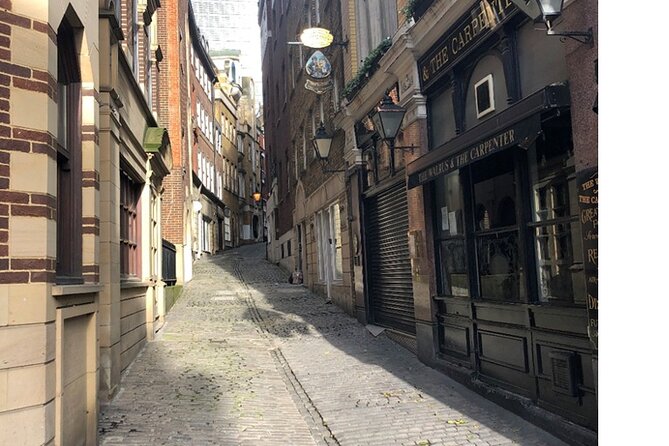
Mansion House is the official home of the Lord Mayor of London. Here, you examine the building’s architecture and its role in the City’s civic history.
The stop adds a useful contrast to the Bank of England. One building represents central banking, while the other represents the ceremonial and political life of the City of London. Together, they show why the City is more than a business district.
The information supplied does not say that you enter Mansion House, so treat it as an exterior stop with commentary. That is also why the five-minute timing makes sense. You see the architecture, learn who uses the building, and continue along the route before the experience turns into a lengthy building tour.
I find this type of stop valuable because it teaches you how London’s institutions are arranged. Once you understand the roles of the cathedral, the bank, and the Lord Mayor’s residence, the City’s grand buildings begin to feel connected rather than scattered.
Guildhall, Roman London, and St. Lawrence Jewry
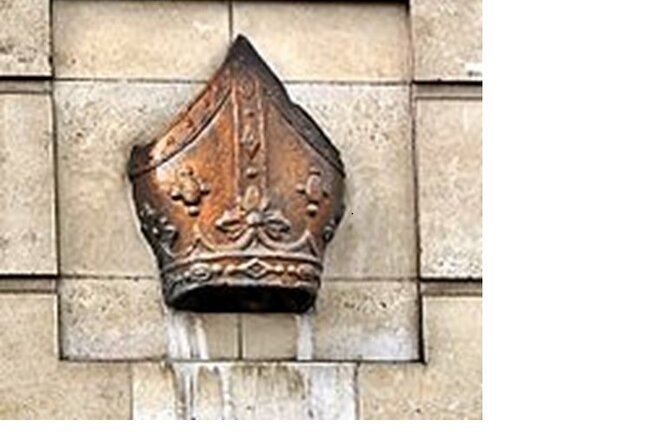
Guildhall is the final listed stop and one of the most varied. It is the ancient seat of the Corporation of London, and the visit takes in the medieval building, the Roman amphitheatre, and St. Lawrence Jewry, the ornate church associated with Christopher Wren.
This is a strong finish because several periods meet in one place. You move from Roman London to medieval government and then to a later church shaped by one of the city’s most important architects. It is a compact lesson in how London was rebuilt and reused over many centuries.
The Roman amphitheatre is especially important to the route’s larger message. The City is not only about the buildings you see today. Earlier London survives in fragments, foundations, and places that reveal how long this district has served as a center of public life.
As with the other stops, the listed time is short. You should not expect a full archaeological tour or an extended church visit. Instead, Sam uses Guildhall to pull together the main themes: power, performance, religion, architecture, and the changing city.
The writers that give the walk its wider frame
Shakespeare is the most obvious name, but he is not the only writer covered. The tour also includes Chaucer, Wordsworth, and T.S. Eliot.
That range gives the experience more shape than a single-author walk. Chaucer brings medieval London into view. Shakespeare links the City to theatre and urban life. Wordsworth offers a later perspective on London, while T.S. Eliot brings the story into the modern age.
You should expect discussion rather than a formal reading session. The central question is how these writers connect to London and what the city meant in their work. If you enjoy literature but do not want a heavy academic lecture, the format sounds approachable.
Sam’s ability to answer questions is another practical advantage. People who have taken his other walks describe him as easy to listen to, accommodating, and willing to engage with everyone in the group. That matters on a private walk, where you can shape the conversation around Shakespeare, architecture, local history, or the City itself.
What Sam’s guiding style adds
The clearest strength of this experience is the guide. Sam is identified as a Cambridge University literature graduate, and his other walks cover subjects ranging from City history to Jewish stories and the secrets of London.
The descriptions of his style point to a guide who mixes facts with stories and humor. That is a good fit for a two-hour walk. Dense information can become tiring when you are standing on a pavement, but short stories and a relaxed tone help the time move quickly.
Sam has also helped long-time locals see their own area differently. That is worth noting if you have already visited London several times. You may not get a list of only famous attractions. You may instead learn why a building matters, what used to occupy a site, or how a familiar corner fits into a much older story.
The private format should make it easier to ask for more detail. A group interested in Shakespeare can keep that thread going. A group more interested in architecture can focus on St. Paul’s, Mansion House, Guildhall, and St. Lawrence Jewry.
Price, group size, and practical value
The price is $388.19 per group of up to 10 people. That is a high total for a two-hour walk if you are booking alone or with only one other person. For a full group, the calculation changes to about $38.82 per person.
At maximum capacity, the private setting can offer good value for a family, group of friends, or work team. You are paying for a dedicated guide rather than joining a large public group, and the subject combines literature, architecture, civic history, and Roman London.
For a small party, the cost is harder to justify unless you place a high value on a private guide and tailored questions. The tour does not include transport, bottled water, or stated admission to interiors. Its value rests on the guide’s interpretation, the convenience of a private booking, and the concentrated route.
The two-hour length is practical for a morning in London. You can use it as an introduction to the City, then continue on your own. Since the walk returns to the meeting point, you finish where you started at the City of London Information Centre beside St. Paul’s Churchyard.
Confirmation arrives at booking, mobile tickets are accepted, and the tour is offered in English. Service animals are allowed, the route is near public transportation, and most people can participate. You should still be ready for an outdoor walk and changing London weather.
Free cancellation is available if you cancel at least 24 hours before the local start time. Changes or cancellations within 24 hours are not accepted for a refund.
Who will get the most from this London walk
I would choose this for a private group that wants a strong introduction to the City without spending half a day inside museums. It suits readers who enjoy stories about writers but also want buildings, institutions, and urban history around them.
It is a good match for:
- Families with adults or older children who enjoy history and literature
- Friends sharing the cost across a larger group
- Work teams looking for a two-hour activity with a clear theme
- Repeat London visitors who want fresh facts about familiar streets
- Visitors interested in Shakespeare, Chaucer, Wordsworth, or T.S. Eliot
- People who prefer conversation and questions to a recorded audio tour
I would be more cautious if your priority is entering St. Paul’s Cathedral, visiting a museum, or spending a long time at each site. The listed route is fast, and the five-minute stops favor explanation over extended sightseeing.
Should you book this City of London experience?
Book it if you want a private, guide-led introduction to London’s literary and civic heart, especially if your group can share the cost. Sam’s literature background, the Shakespeare focus at Blackfriars, and the mix of Roman, medieval, Baroque, and modern connections give the walk a clear identity.
Skip it if you want a full-day literary tour or guaranteed interior access. This is a brisk two-hour orientation, not a succession of long visits. Its best quality is the way Sam can make ordinary City streets feel worth a second look.
FAQ
How much does the tour cost?
The price is $388.19 per group, with up to 10 people included.
How long does the walking tour last?
The tour lasts approximately two hours.
Where does the tour start?
It starts at the City of London Information Centre, St. Paul’s Churchyard, London EC4M 8BX, UK.
What time does the tour start?
The listed start time is 7:00 am.
Where does the tour end?
The activity ends back at the meeting point.
Is this a private tour?
Yes. Only your group participates in the activity.
Which writers are covered?
The tour covers Shakespeare, Chaucer, Wordsworth, and T.S. Eliot, among other London literary connections.
Is transportation included?
No. Private transportation is not included.
Can I cancel for a full refund?
Yes, if you cancel at least 24 hours before the experience start time. Cancellations made less than 24 hours in advance are not refunded.
Just added around London
- Private The Beatles Taxi Tour in London★ 5.0 · 12 reviews
- Dinner and Jazz Cruise on the River Thames★ 4.0 · 140 reviews
- Airport Coach Service from Heathrow to Oxford★ 3.5 · 67 reviews
- The Alfred Hitchcock London Walk with Sandra Shevey★ 5.0 · 15 reviews
- Tower of London & 30+ London Sights Walking Tour★ 4.5 · 33 reviews
- Thames Beachcombing★ 4.5 · 100 reviews
- Ted Lasso London Taxi Tour★ 5.0 · 5 reviews
- Ted Lasso Tour of Richmond with Private Guide★ 5.0 · 25 reviews
Walking Tours, compared.
Oxford University Walking Tour With University Alumni Guide
Read our review →
Tour for Muggles The Ultimate Harry Potter Walking Tour in London
Read our review →
Cambridge University Walking Tour by Alumni™ Kings College Option
Read our review →
Blackbeard to Banksy – The Ultimate Walking Tour of Bristol
Read our review →
Air Raid Shelter + St. Nicholas Market Walking Tour
Read our review →
Walking Tour of Bath with Blue Badge Tourist Guide
Read our review →