
Reviewed · PHOTOGRAPHY SESSIONS
History of London Photography Tour
London reveals itself differently through a camera. This two-hour walking tour moves from St. Mary Woolnoth in the City to Tate Modern, using churches, financial buildings, monuments, bridges, and riverside views as a working photography class. You get London history along the way, but the main point is learning how to frame familiar places with fresher eyes.
I like two things right away: the route links major sights with less obvious architectural details, and the guide helps you use the camera you already have. Richard, one guide named in the tour feedback, was especially good at helping people adjust settings before the walk. The main consideration is pace. Ten stops in about two hours means you will photograph quickly rather than spend long periods at each site.
Key points
- A City of London to South Bank route: Start at St. Mary Woolnoth and finish at Tate Modern, passing St. Paul’s and Millennium Bridge.
- Practical camera coaching: Get help with composition, lighting, camera settings, and ways to move beyond automatic mode.
- Free-entry photo stops: The tour photographs exteriors and public views, so no attraction admission is included or needed.
- A small-group setting: The maximum group size is 18, large enough for varied abilities but not an intimate private lesson.
- History with a visual purpose: Churches, banks, war memorials, and bridges give you subjects with a story, not just a checklist of landmarks.
- Bring a camera or phone: The tour is useful with a DSLR, other camera, or camera phone, but you need your own device.
Starting beneath Hawksmoor’s St. Mary Woolnoth
Meet outside IMPRINT Church London, St. Mary Woolnoth, at 10 to 13 Lombard Street. This puts you right in the heart of the City of London, where modern finance crowds around a church site used for worship for at least 2,000 years.
The present church was rebuilt in 1727 and commissioned from Nicholas Hawksmoor. That gives you an immediate lesson in contrast: an old religious building squeezed among tall commercial structures, with strong lines, dark stone, and changing light depending on the time of day.
The guide begins by helping you get set up. This matters more than it sounds. One of the strongest parts of the experience is the chance to check camera settings before walking away from the meeting point. If you have become too dependent on automatic mode, this is a useful nudge back toward deliberate photography.
You spend about 10 minutes here. Admission is free, and you photograph from public areas rather than entering as part of a paid sightseeing visit. The church is a good opening subject because it offers architecture, history, and a tight urban setting in one place.
A few more London trips to weigh up
- Professional Photoshoot in London Photographer
★ 5.0 · 102 reviews - Private landmarks photoshoot for families and couples
★ 5.0 · 92 reviews - Professional Private Photoshoot in London
★ 5.0 · 63 reviews
Framing the Royal Exchange and Bank of England
The next stops bring you into the City’s financial core. At the Royal Exchange, the guide shows you how to photograph a grand building that can be hard to capture in a crowded urban setting. Look for symmetry, columns, roof details, and the way surrounding streets frame the building.
You have around 10 minutes here, so expect a focused exercise rather than a long architectural study. The value comes from learning how to find a workable angle quickly. That is a useful skill in London, where busy pavements and large buildings often leave little room for a perfect viewpoint.
The Bank of England follows, with about 15 minutes devoted to its architecture and history. This is a strong stop for photographers who enjoy mass, texture, and repeated patterns. Your guide can help you decide how much of the building to include and how to avoid making a large facade look flat.
The route also gives you a feel for the City itself. This is not the London of palace gates and red buses. It is a district of old institutions, narrow streets, stone facades, and newer towers. A camera helps you notice the odd juxtapositions.
Gothic detail at the 800-year-old Guildhall
Guildhall receives about 15 minutes, making it one of the longer stops. The building’s Gothic character gives you a different subject from the classical financial buildings nearby.
The focus here is on finding a strong photograph among elaborate architectural features. You might work with vertical lines, pointed details, shadow, and the contrast between old stone and the modern City around it. The guide’s job is not just to point out the building, but to help you decide what deserves the frame.
Guildhall is also useful for the history lesson. It is around 800 years old and remains one of the City’s most important historic buildings. You do not need to be an experienced photographer to benefit from this stop. Beginners get a clear subject to work with, while more confident photographers can experiment with details instead of taking only a full-building picture.
Listening for Cockney tradition at St. Mary-le-Bow
At St. Mary-le-Bow, the tour turns to one of London’s best-known church traditions. According to local custom, a true Cockney is born within earshot of the church bells.
You have about 10 minutes to photograph the church. This is another chance to look beyond a standard postcard view. The building can be treated as an architectural subject, but its bells and local tradition give the image a human story as well.
I like this kind of stop because it connects photography with place. You are not simply collecting buildings. You are learning why a particular structure matters to Londoners and then using that context to guide your image.
Same country, a completely different day out:
- Stonehenge, Windsor Castle, and Bath from London
★ 4.5 · 18,662 reviews - London Big Bus Hop-On Hop-Off Tour with Optional River Cruise
★ 3.5 · 10,803 reviews - London Small Group Tour of Historical Pubs
★ 5.0 · 10,422 reviews - Stonehenge, Windsor Castle and Bath with Pub Lunch in Lacock
★ 4.5 · 7,402 reviews
Making St. Paul’s work from the street
St. Paul’s Cathedral gets roughly 20 minutes, the longest stop on the City side of the walk. It is one of London’s most recognizable buildings, so the challenge is avoiding a routine photograph.
The cathedral has witnessed major events, including the marriage of Catherine of Aragon to Prince Arthur in 1501 and Queen Elizabeth I’s visit after the defeat of the Spanish Armada in 1588. The guide also covers its connection with the punishment of Guy Fawkes and his fellow conspirators after the failed attempt to blow up Parliament.
Those stories give you a reason to pause before pressing the shutter. You can think about scale, ceremony, and the building’s role as the nation’s church. The guide helps you find a useful angle, which may mean including surrounding streets, isolating architectural details, or using the cathedral as part of a wider City composition.
The drawback is familiar to anyone photographing St. Paul’s: it is large, popular, and surrounded by urban clutter. You should expect guidance, not an empty square reserved for your group.
A wartime story at the National Firefighters Memorial
The National Firefighters Memorial adds a human subject to the route. Sculptor John Mills created the monument to honor the professional firefighters, men, and women who helped London survive the Blitz.
You spend about 10 minutes here. The monument works well for dramatic images because the figures carry movement and emotion, while nearby London landmarks provide scale. Your guide can help you decide how tightly to frame the statue or how to place it against the city behind it.
This is one of the tour’s more meaningful photo stops. A building can be impressive, but a memorial asks you to think about people and sacrifice. It also breaks up the architecture-heavy middle section of the walk.
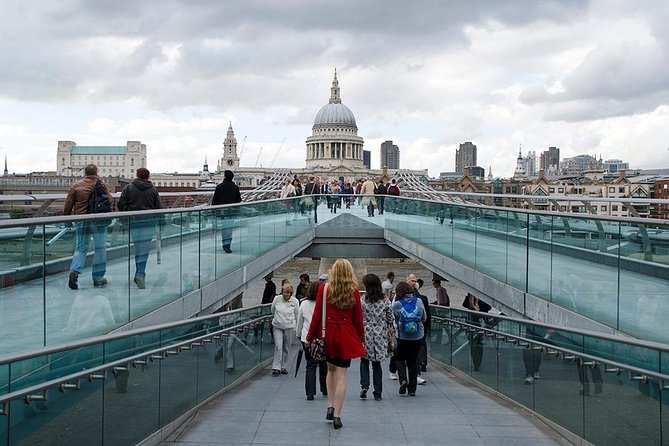
Crossing Millennium Bridge with St. Paul’s behind you
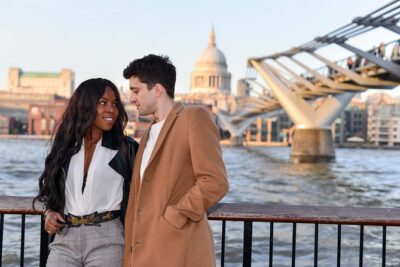
The 325-meter Millennium Bridge links Tate Modern with the City of London and St. Paul’s Cathedral. Opened on June 10, 2000, it gives you one of the clearest chances to work with strong perspective lines.
Bridges are friendly photography subjects. Their rails, walkway, and structure naturally lead the eye into the frame. You can also turn around and use the bridge as a route toward St. Paul’s, or look across the Thames toward the South Bank.
The guide helps you make better use of the view rather than simply telling you where to stand. About 10 minutes is enough for several compositions, but not enough for slow experimentation in changing light. Keep your camera ready and listen for quick suggestions about balance, direction, and framing.
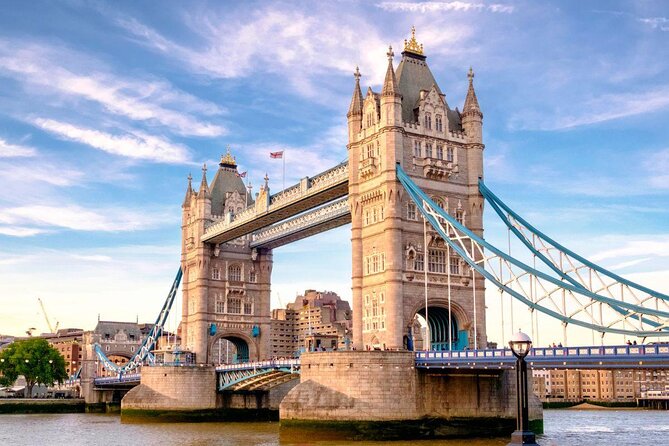
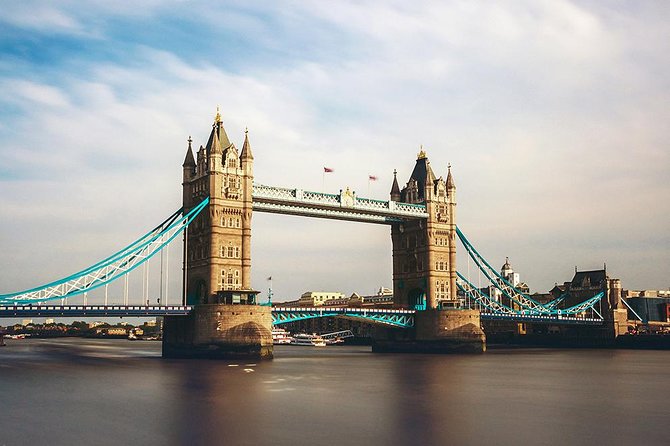
Riverside views toward Tower Bridge
The Tower Bridge stop offers panoramic views of the Thames and the bridge itself. It is another 10-minute photography session, and the riverside setting gives you a wider, more open subject after the tight streets of the City.
This is the point where light matters most. Water, sky, bridge towers, and distant buildings can create a strong broad composition, but the view may also feel familiar. The guide’s input is valuable if you want to avoid a basic tourist snapshot.
The route description does not promise entry to Tower Bridge, and admission is not included. Treat this as an exterior viewpoint and a chance to work with the river, not an inside visit.
Ending with Tate Modern’s brick power station
The tour finishes at Tate Modern on Bankside, London SE1 9TG. You spend about 10 minutes photographing the building, which occupies the former Bankside Power Station.
Sir Giles Gilbert Scott designed the power station, the same architect associated with Battersea Power Station. Its tall brick form dominates this part of the South Bank and gives you a final subject with a strong industrial character.
Tate Modern is also Britain’s national gallery of international modern art, but this experience ends outside rather than functioning as an art museum tour. That is worth knowing if you hoped to visit the galleries as part of the two hours. Instead, the final stop gives you a clear endpoint near one of London’s major cultural sites.
Finishing here is practical. You can continue into Tate Modern on your own, walk along the South Bank, or use nearby public transport. The tour itself does not include museum admission.
What the photography coaching is really worth
At $71.63 per person, this is not priced like a basic sightseeing walk. You are paying for a professional photographer guide, camera advice, history, and a route built around image-making. The value depends on how much you want the coaching.
If you already take photographs often and want a highly technical workshop, the tour may feel introductory. The group can include different ages and skill levels, and the maximum is 18 people. That makes the experience accessible, but it also means the guide cannot give every person a private lesson at every stop.
For beginners, the price is easier to justify. You get a practical reason to stop using automatic settings, along with real subjects to photograph. One useful detail from the tour feedback is that people with different abilities could take part, including those who were new to this part of London.
You can also use a camera phone. The experience specifically requires you to bring a camera or camera phone to get the most from it. Do not book this expecting the guide to supply equipment or provide finished photographs.
The strongest teaching appears to be composition, lighting, camera settings, and choosing better angles. The advice is meant to help you build your own personal portfolio of London, not simply receive a lecture about photography.
The route is creative, but it is not a secret-London expedition
The walk includes backstreets and less obvious viewpoints, but it also visits major landmarks. That balance is important. You will photograph St. Paul’s, Tower Bridge, Millennium Bridge, the Royal Exchange, and the Bank of England, so anyone expecting only obscure corners may find the route too standard.
I see that as a fair trade for a first London photography session. Famous buildings give beginners clear subjects and make the history easy to follow. The guide then helps you find a less routine angle, which is often more useful than chasing a place few people recognize.
The experience works best if you approach it as a creative sightseeing walk, not a private portfolio assignment. You may get fresh photographs of familiar places, but the exact result depends on light, group pace, and how much individual help you need.
Timing, group size, and walking demands
The tour lasts about two hours and includes 10 stops. The listed stop times add up to roughly two hours, so the schedule is tight. You will walk between locations and need to be ready to shoot when the group arrives.
A maximum of 18 people is moderate for a city walk. It is not the same as having a personal photographer beside you, but it should allow a guide to offer general corrections and answer questions. The named guide Richard was praised for being friendly, supportive, and good at helping people with camera settings. Guide assignments can vary, so do not assume he will lead every departure.
The start and finish are on opposite sides of the Thames. You begin near Bank and end at Tate Modern, which is useful if you want to connect the tour with another South Bank activity. Public transportation is nearby, and most people can participate. Service animals are allowed.
The tour has a minimum age of 18. Children may attend only when accompanied by an adult, and both need paid tickets. Check the weather before booking, since poor conditions can cancel the experience.
Who will get the most from this walk
I would choose this tour if you fit one of these descriptions:
- You want to improve composition and camera settings while seeing central London.
- You have been relying on automatic mode and want a friendly push toward more control.
- You prefer an active, creative walk to a standard history tour.
- You are a London resident who knows the landmarks but wants to photograph them differently.
- You want a short experience that ends near Tate Modern and the South Bank.
I would hesitate if you want long visits inside the churches, Bank of England, St. Paul’s, or Tate Modern. The tour visits these places as photo subjects, and admission is not part of the experience.
I would also think twice if your only goal is rare, unknown views. The route includes some less obvious features, but it is built around well-known City and riverside landmarks. Its fresh perspective comes mainly from the guide’s photography advice, not from avoiding famous sights altogether.
Should you book the History of London Photography Tour?
Book it if you want to learn by photographing real London subjects rather than sitting in a classroom. The mix of Hawksmoor architecture, financial buildings, memorial sculpture, St. Paul’s, bridges, and Tate Modern gives you plenty to work with in a short time.
The best match is a beginner or intermediate photographer who wants practical help and a relaxed guide. Bring your own camera or phone, expect a brisk pace, and arrive ready to make decisions rather than wait for perfect conditions.
At $71.63, the tour is good value when the photography lesson matters as much as the sightseeing. If you want a slow, highly specialized workshop or an inside visit to London’s major attractions, spend your money elsewhere. If you want to see the City from a camera’s point of view and leave with techniques you can use again, this is a sensible choice.
FAQ
How long is the History of London Photography Tour?
The tour lasts approximately two hours.
Where does the photography tour begin?
It begins at IMPRINT Church London, St. Mary Woolnoth, at 10 to 13 Lombard Street, London EC3V 9AN.
Where does the tour end?
The tour ends at Tate Modern, Bankside, London SE1 9TG.
What equipment should I bring?
You need to bring your own camera or camera phone to get the most from the experience.
Is admission to the sights included?
The listed stops have free admission, and the tour includes guided photography advice and historical information. Tate Modern admission is not listed as part of the experience.
What is the maximum group size?
The tour can have a maximum of 18 participants.
Is there a minimum age?
The minimum age is 18. Children must be accompanied by an adult, and both the child and adult must have paid tickets.
What happens if the tour is canceled because of weather?
If poor weather causes a cancellation, you will be offered another date or a full refund. The experience may also be canceled if the minimum number of participants is not reached, with a different date, another experience, or a full refund offered.
Just added around London
- Private The Beatles Taxi Tour in London★ 5.0 · 12 reviews
- Dinner and Jazz Cruise on the River Thames★ 4.0 · 140 reviews
- Airport Coach Service from Heathrow to Oxford★ 3.5 · 67 reviews
- The Alfred Hitchcock London Walk with Sandra Shevey★ 5.0 · 15 reviews
- Tower of London & 30+ London Sights Walking Tour★ 4.5 · 33 reviews
- Thames Beachcombing★ 4.5 · 100 reviews
- Ted Lasso London Taxi Tour★ 5.0 · 5 reviews
- Ted Lasso Tour of Richmond with Private Guide★ 5.0 · 25 reviews
Photography Sessions, compared.
Professional Photoshoot in London Photographer
Read our review →
30 Major London Attractions Walking Tour With Photos
Read our review →
Browse the lists this tour appears in