Reviewed · WALKING TOURS
London’s Ghosts & Gruesome Past Nighttime Walking Tour
London’s darkest stories unfold on ordinary streets in this two-hour walk from Farringdon to the Old Bailey. You’ll hear about a ghostly girl at the station, public executions at Smithfield, plague pits beneath Charterhouse Square, and grave robbers who supplied bodies to doctors.
I like the way this tour ties gruesome tales to real places, rather than keeping the scares vague and theatrical. I also like the small maximum of 20 people, which should make it easier to hear guides such as Matt or Carolina as they tell the stories.
The main drawback is the subject matter itself. Executions, disease, torture, child victims, body snatching, and murder are not softened for polite company. You’ll also be walking outdoors after dark, so sturdy shoes and weather-ready clothing matter.
Key points to know before you book
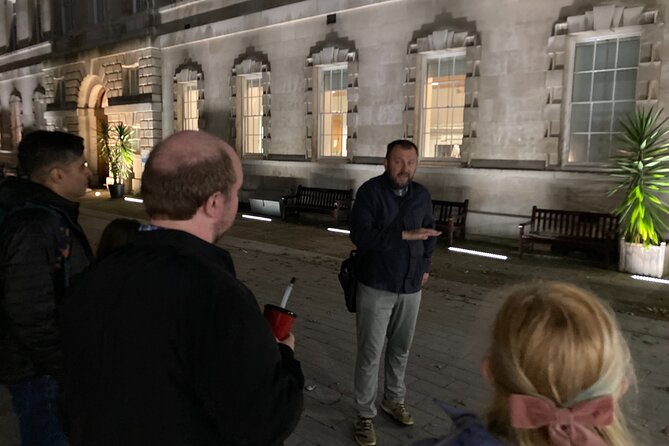
- Nine atmospheric stops: The route links Farringdon, Smithfield Market, Charterhouse Square, St. Bartholomew’s Church, St. Bartholomew’s Hospital, Holy Sepulchre London, and Old Bailey.
- History carries the scares: The ghost stories sit beside documented tales of plague, punishment, medicine, and crime.
- Small group size: The tour accepts a maximum of 20 people, a useful limit for a spoken walking tour.
- An evening start: Meet at 6:00 pm outside Cafe Pronto by Farringdon Station and finish near St. Paul’s Underground Station.
- Good value for a focused walk: At $49 per person, the price pays for a two-hour guided experience in central London, with no extra admission fees listed.
- A guide makes the difference: Matt is praised for his patient pace and storytelling, while Carolina is described as bringing strong energy to the subject.
Why this London night walk works
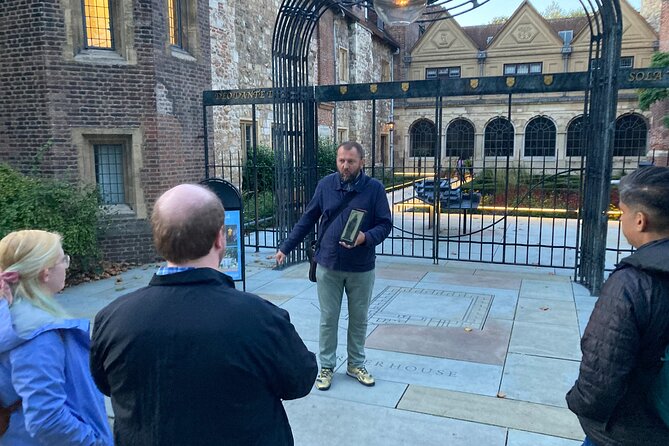
This is not a haunted-house attraction with props and jump scares. It is a guided look at the people, places, and beliefs that shaped London’s grim reputation. The supernatural material gives the evening its mood, but much of the tour rests on social history: how London punished criminals, handled disease, treated patients, and dealt with the dead.
That mix is the tour’s best feature. You can enjoy it as a ghost walk, but you’ll also come away with a sharper sense of how harsh city life once was. A quiet churchyard becomes a clue to plague burials. A hospital courtyard points to crude surgery. A courthouse recalls an earlier prison and a notorious killer.
The walk begins at 6:00 pm, when darkness can help create the right mood. London streets can still be noisy at that hour, especially around transport links and central roads, so you’ll need to stay close and listen carefully. The group size of no more than 20 helps, but this is still an outdoor storytelling tour, not a private room with perfect acoustics.
A few more London trips to weigh up
- Tour for Muggles The Ultimate Harry Potter Walking Tour in London
★ 5.0 · 4,684 reviews - London Jack The Ripper Guided Walking Tour
★ 5.0 · 3,131 reviews - Changing of the Guard Guided Walking Tour in London
★ 5.0 · 1,793 reviews
Farringdon and the ghost beneath the station
Meet your guide outside Cafe Pronto at Farringdon Station, 43 Cowcross Street. The first story concerns a young girl said to haunt the station, with a tragic tale reaching back to the 18th century.
The guide uses the location well. You begin with a modern station, people moving through the area, and the familiar warning to mind the gap. Against that everyday setting comes a story of mistreatment in life and a disturbing fate after death. The contrast gives the opening its force.
This stop lasts about 10 minutes. You won’t enter an attraction or receive a special admission. The interest comes from listening, looking, and deciding how much of the story you accept. The guide may point out what some people claim to see, but the tour leaves room for you to judge the haunting for yourself.
Because Farringdon is active and noisy, arrive ready to focus. A guide with a clear voice matters here. Matt has been praised for good communication and a pleasant walking pace, while his slight accent was easy to follow once the group adjusted to it.
Smithfield Market and London’s public punishments
The short walk to Smithfield Market shifts the mood from ghost story to public violence. For centuries, this area was linked with executions, where people were tortured and killed in front of crowds.
Your guide asks you to picture the setting before the modern city covered much of the old scene. The details are harsh, and the tour does not hide the inventive methods used by executioners. This is history presented for its shock, but it also says something about public punishment in earlier London: death was not private, and crowds came to watch.
The stop takes around 15 minutes. Smithfield is still tied to meat trading, which creates an uncomfortable link between the area’s present use and its older associations with blood and death. If you prefer historical context to graphic description, listen for the larger point about law, spectacle, and power.
Charterhouse Square and the plague pits below
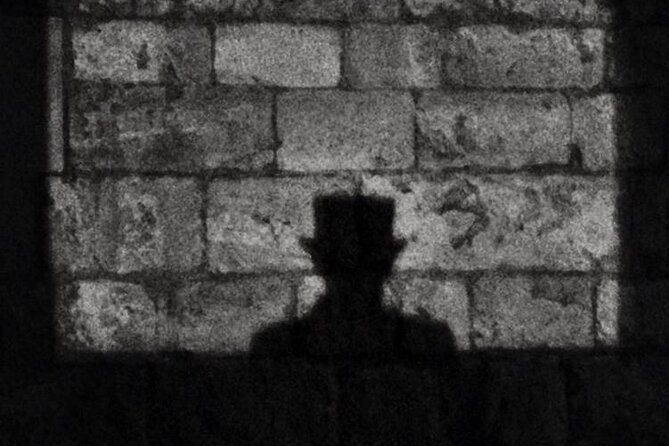
Charterhouse Square offers a brief change of pace. Today it is a peaceful green space, but the ground beneath and around it recalls repeated outbreaks of plague.
The guide explains how disease changed London, how deadly it could be, and what doctors tried in response. You’ll hear about the people who died, those who survived, and the uncertain medical ideas of the time. The image of plague pits beneath your feet makes the subject immediate without requiring a museum visit.
This 15-minute stop is less about ghosts than the unsettling fact that ordinary public spaces can sit above mass burial sites. The warning about snakes on the benches adds a touch of dark humor before the talk moves into disease and death.
This section may appeal most to visitors who like social history. It shows that the city’s gruesome past was not limited to criminals and haunted buildings. Epidemics could affect whole communities, and the medical response was often frightening in its own right.
Same country, a completely different day out:
- Stonehenge, Windsor Castle, and Bath from London
★ 4.5 · 18,662 reviews - London Big Bus Hop-On Hop-Off Tour with Optional River Cruise
★ 3.5 · 10,803 reviews - London Small Group Tour of Historical Pubs
★ 5.0 · 10,422 reviews - Stonehenge, Windsor Castle and Bath with Pub Lunch in Lacock
★ 4.5 · 7,402 reviews
Cloth Fair and the pub before the execution
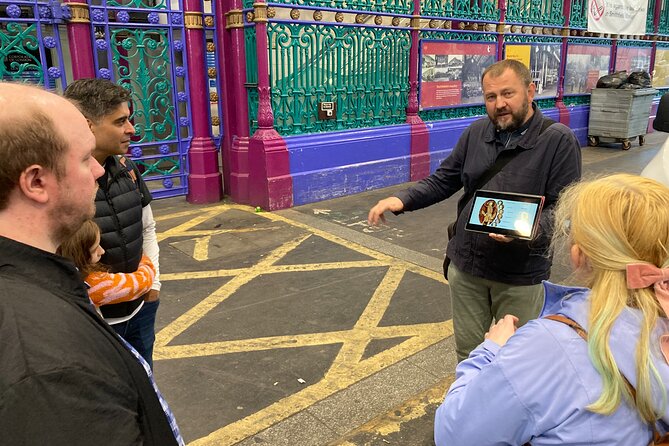
At Cloth Fair, the guide connects drinking culture with public executions. You’ll hear where people could get a drink before heading to watch a condemned person die.
The stop lasts about 10 minutes, so expect a short story rather than a long lecture. Its value lies in showing how execution days became public events, with nearby businesses serving the crowds. That detail makes the practice feel less remote. It was not only a legal act, but also part of the city’s entertainment and commercial life.
This is one of the places where the route’s structure works well. You move from the execution site at Smithfield to the surrounding streets and consider what happened before and after the spectacle.
St. Bartholomew the Great and the disturbed dead
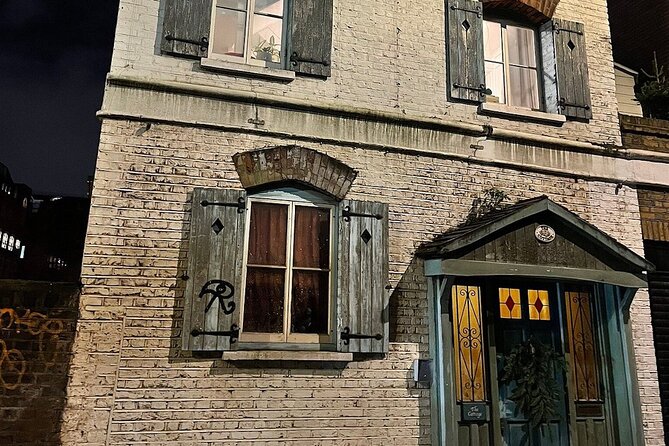
The route then passes through narrow passages and old streets toward St. Bartholomew the Great, one of London’s oldest churches. The setting becomes quieter, with old tombstones and a graveyard that suits the ghostly side of the evening.
The church has served people for roughly nine centuries, both living and dead. Here the guide tells the story of its founder, whose burial did not bring the rest he expected. Something is missing from his remains, and the tale turns toward revenge from beyond the grave.
You spend about 15 minutes in this area. The attraction is not simply the age of the church. It is the way the old stone, narrow lanes, and grave markers support the story without the need for stage effects.
I would take a moment to look around while the guide speaks, but stay attentive. The stories move quickly, and the point is not just to admire the church. It is to connect the building’s long service to the people buried around it and the beliefs attached to their remains.
William Wallace and the facts behind the film
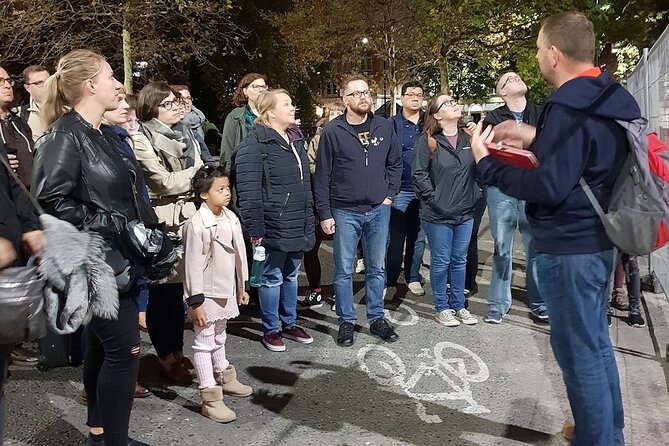
At the William Wallace Memorial, the tour leaves London’s local ghosts for a famous figure from the conflict between England and Scotland. The guide recounts Wallace’s triple execution and its later consequences for the relationship between the two countries.
You’ll also hear which parts of the popular film about Wallace are inaccurate. That makes this a useful pause in the tour. It separates remembered legend from historical detail and reminds you that famous screen stories often reshape violent events for drama.
The stop takes around 10 minutes. It may feel less connected to London’s haunted places than the churchyards and plague pits, but it adds political history and gives the evening a wider frame. The memorial also provides a clear physical marker for a story many people already know in simplified form.
St. Bartholomew’s Hospital and old medical practice
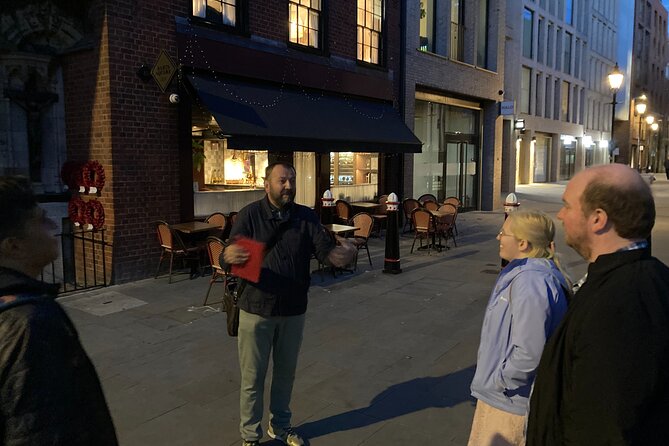
The hospital yard brings some of the evening’s most uncomfortable material. St. Bartholomew’s Hospital and the nearby church share a patron and a long connection, but the guide focuses on the medical methods once used inside and around the institution.
You’ll hear about treatments people swallowed, ate, or smeared on their bodies in the hope of getting well. The tour also covers doctors who did not wash their hands, patients sharing beds, and operations watched by an audience.
Surgery and amputation were public events in ways that seem shocking now. Even watching could be dangerous, according to the grim story told here. The point is not to mock earlier doctors. It is to show how limited medical knowledge and poor hygiene could turn care into another source of danger.
This stop lasts roughly 15 minutes. It is a strong match for anyone interested in medical history, but it may be the wrong choice if you dislike graphic descriptions of illness or surgery. You remain outside in the hospital yard, so the guide’s storytelling carries the scene.
Holy Sepulchre London and the body-snatching trade
At Holy Sepulchre London, the story turns to empty graves and the trade in dead bodies. The churchyard’s missing graves recall a time when people made money by taking bodies and selling them.
The guide explores the uncomfortable line between stealing and taking, then links the trade to two nearby places already seen on the walk: the hospital and the pub. Doctors wanted bodies for medical study, and people connected with the executions and drinking culture had opportunities to obtain them.
This is a good example of how the route joins separate stories. The earlier hospital stop explains who might buy a corpse. The nearby pub and execution stories help explain how a body could disappear into a profitable network.
The stop lasts about 15 minutes and ends with a particularly disturbing account of how the practice came to an end. You should expect questions of law and profit, not just a simple tale of villains. The history is unsettling because the demand came from a real need for medical knowledge, while the supply depended on people violating the dead and the families left behind.
Old Bailey and the final killer
The walk ends near 19 Old Bailey, outside the famous courthouse and close to St. Paul’s Underground Station. This final stop covers the site of an earlier prison and introduces a killer described by the guide as worse than the name most people expect, Jack the Ripper.
The story concerns an ordinary-looking woman with a chilling method, a focus on innocent victims, and a financial motive. She was caught twice and still continued, which gives the tale its disturbing turn. The guide also brings in her daughter, adding a family element to an already bleak case.
The stop runs around 15 minutes and is designed as the evening’s grim finish. That choice makes sense. The tour has moved from ghosts to executions, disease, medicine, grave robbing, and now deliberate murder. You finish with the most personal kind of horror, the calculated killing of people who had done nothing to deserve it.
The end point is practical as well as dramatic. You are within walking distance of St. Paul’s Underground Station, so you can continue into central London or head back to your accommodation after the tour.
Guides, group size, and the walking pace
The experience includes a local guide, and the guide’s storytelling ability will shape your evening. Matt receives particular praise for patience, a steady pace, and willingness to answer questions. Carolina is described as bringing passion and energy to London’s stories.
You should expect a spoken tour rather than a performance with costumes or special effects. One Halloween group had a guide dressed in a mask and cape, but that should be treated as seasonal atmosphere rather than a standard feature.
The maximum group size is 20. That is small enough to keep the group together and give you a fair chance of hearing the guide, though busy streets can still create interruptions. The walk includes several short stops of 10 to 15 minutes, with movement between them.
Wear comfortable shoes and bring a coat or rain layer. A little drizzle can add to the mood, but it can also make the two-hour walk tiring. You’ll be outside for the full route, and the tour does not list indoor admissions.
Is $49 a fair price?
At $49 per person, this is not the cheapest way to spend an evening in London. The value depends on how much you want a guide to connect these places and tell the stories in sequence.
You are paying for two hours with a local guide, a carefully focused route, and access to stories that would be difficult to assemble on your own. There are no listed admission charges, and most of the sites are viewed from public streets, churchyards, or exterior areas. If you already know London well and prefer to read plaques at your own pace, the price may feel high.
For a first visit, or for an evening with a strong interest in crime, ghosts, and old medical practice, the cost is easier to justify. The route covers several areas in one outing, including Farringdon, Smithfield, Charterhouse Square, St. Bartholomew’s, and Old Bailey. A taxi or self-guided walk would not provide the same narration or pacing.
The 4.9 rating from 26 reviews and a 100 percent recommendation mark suggest a strong record, but I would still focus on the tour’s subject matter. The value is highest when you want gruesome storytelling grounded in London locations.
Who should book this tour?
Book it if you enjoy ghost stories with a real historical base, especially tales about executions, plague, medicine, and crime. It also suits repeat visitors who want to see old parts of the City from a darker angle.
The experience is not limited to horror fans. You might like it if you enjoy urban history, old churches, medical practices, or the gap between popular legend and documented fact. The William Wallace section, for example, adds a useful check on film history.
I would think twice if you dislike graphic stories about torture, death, surgery, disease, or murder. The tour is also less suitable for anyone wanting a relaxed sightseeing walk with long stops and time for photographs. Its purpose is storytelling, and the tone is deliberately grim.
Most people can participate, service animals are allowed, and the tour is near public transport. Confirmation arrives when you book. Free cancellation is available up to 24 hours before the 6:00 pm start, while later cancellations and changes are not accepted. The tour requires a minimum number of participants, so a cancellation for that reason brings a choice of another date or a full refund.
Should you book London’s Ghosts & Gruesome Past?
I’d book this tour if you want London’s old streets to feel unsettling for an evening. The best parts are the links between places: the church and its dead, the hospital and stolen bodies, the execution ground and nearby pubs, and the courthouse built over a former prison.
Choose a guide-led night walk instead of a standard sightseeing tour if you value atmosphere and sharp storytelling more than grand interiors. Bring good shoes, dress for damp weather, and keep an open mind about the ghost stories. The facts are grim enough even when the supernatural claims remain uncertain.
FAQ
Where does the tour begin?
The tour begins at 6:00 pm outside Cafe ProntoFarringdon Station, at 43 Cowcross Street, London EC1M 6BY.
Where does the tour finish?
The walk finishes at 19 Old Bailey, London EC2A 9EA, within walking distance of St. Paul’s Underground Station.
How long is the tour?
The walking tour lasts approximately two hours.
How much does the tour cost?
The listed price is $49 per person.
What places are included in the route?
The route includes Farringdon, Smithfield Market, Charterhouse Square, Cloth Fair, St. Bartholomew the Great, the William Wallace Memorial, St. Bartholomew’s Hospital Museum, Holy Sepulchre London, and Old Bailey.
What topics does the guide cover?
The tour covers ghosts, public executions, plague pits, medical treatment, grave robbing, body selling, William Wallace, and notorious murder cases.
How many people can join the tour?
The tour has a maximum group size of 20 people.
Can I cancel for a full refund?
Yes. You can cancel at least 24 hours before the experience start time for a full refund. Cancellations or changes made less than 24 hours before the start are not accepted for a refund.
Just added around London
- Private The Beatles Taxi Tour in London★ 5.0 · 12 reviews
- Dinner and Jazz Cruise on the River Thames★ 4.0 · 140 reviews
- Airport Coach Service from Heathrow to Oxford★ 3.5 · 67 reviews
- The Alfred Hitchcock London Walk with Sandra Shevey★ 5.0 · 15 reviews
- Tower of London & 30+ London Sights Walking Tour★ 4.5 · 33 reviews
- Thames Beachcombing★ 4.5 · 100 reviews
- Ted Lasso London Taxi Tour★ 5.0 · 5 reviews
- Ted Lasso Tour of Richmond with Private Guide★ 5.0 · 25 reviews
Walking Tours, compared.
Oxford University Walking Tour With University Alumni Guide
Read our review →
Tour for Muggles The Ultimate Harry Potter Walking Tour in London
Read our review →
Cambridge University Walking Tour by Alumni™ Kings College Option
Read our review →
Blackbeard to Banksy – The Ultimate Walking Tour of Bristol
Read our review →
Air Raid Shelter + St. Nicholas Market Walking Tour
Read our review →
Walking Tour of Bath with Blue Badge Tourist Guide
Read our review →