Reviewed · WALKING TOURS
Medieval London Walking Tour Oxford PhD Historian Guide
London’s medieval past is easy to miss beneath the traffic, offices, and grand Victorian streets. This private walk brings that older city into focus, linking St. Bartholomew the Great and Temple Church with the walls, prisons, churches, and people that shaped London long before the modern city arrived.
I like the personal scale of the tour and the depth Dr Geoff brings as an Oxford PhD historian. I also like the route itself: you see major landmarks, but you also get the story between them. The main drawback is that two and a half hours on foot, with church visits and outdoor walking, may feel demanding in poor weather or for anyone wanting a slower pace.
Key points to know before booking
- Dr Geoff leads a private walk: Your group has the guide to itself, making it easy to ask questions and follow your own interests.
- St. Bartholomew the Great gets 45 minutes: This Norman church survived the Great Fire, the Reformation, the Civil War, and the Blitz.
- Temple Church connects medieval London with American history: The Knights Templar built it in the 12th century, and its story reaches beyond England.
- The route covers more than famous buildings: You discuss medieval walls, Newgate prison, William Wallace, and the city before the Fire of 1666.
- The walk ends at Temple Church: The final point is the garden at Temple, not the starting point near St. Paul’s.
- The price reflects a private specialist tour: At $122.18 per person, the value depends on how much you want detailed history and one-on-one time with a guide.
Why this route reveals a different London
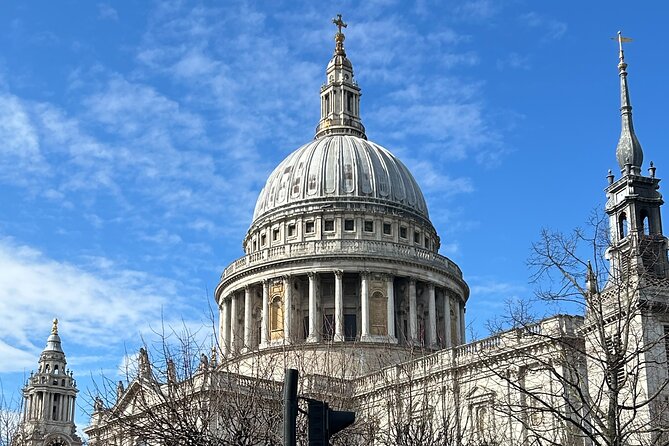
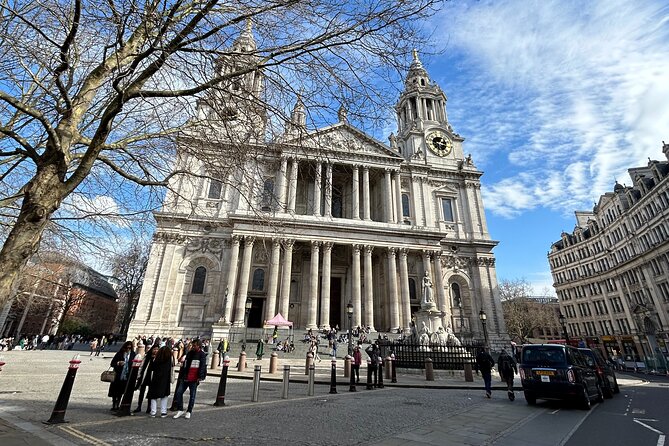
The walk begins at the west end of St. Paul’s Cathedral, near the grand stairs. St. Paul’s is not a medieval building in its current form. Sir Christopher Wren rebuilt it after the Great Fire of 1666, which destroyed much of the old city.
That contrast gives the opening its purpose. You start with the London people recognize today, then look for what survived nearby. Dr Geoff uses Wren and the Fire as a doorway into earlier centuries, explaining what London looked like before the rebuilding.
I like this approach because it avoids treating medieval London as a collection of isolated ruins. A church, street, prison site, and old wall make more sense when you understand how the Great Fire changed the city, and how much of the older city still survived around it.
The walk from St. Paul’s to St. Bartholomew’s takes about 18 minutes. This is not a coach tour with a series of quick photo stops. You move through the city on foot, with the route itself forming part of the lesson.
The meeting time is 10:00 a.m. Look for Dr Geoff wearing a blue lanyard marked Historic Tours of England. The walk finishes at Temple Church, so plan your day around a point-to-point outing rather than returning to St. Paul’s.
A few more London trips to weigh up
- Tour for Muggles The Ultimate Harry Potter Walking Tour in London
★ 5.0 · 4,684 reviews - London Jack The Ripper Guided Walking Tour
★ 5.0 · 3,131 reviews - Changing of the Guard Guided Walking Tour in London
★ 5.0 · 1,793 reviews
William Wallace near St. Bartholomew’s
On the way to St. Bartholomew the Great, the route pauses at the memorial to William Wallace, the Scottish hero who fought for Scottish independence. The stop lasts about 10 minutes and has no admission charge.
This is a small stop, but it adds a human figure to the larger story. Medieval London was not only about kings, bishops, builders, and wealthy religious orders. It was also shaped by conflict between England and Scotland, and by the people caught up in those struggles.
You should not expect a long visit here. The memorial is a brief pause on the way to the church, and its value comes from the context Dr Geoff provides. If you enjoy connecting a physical place with the political struggles of the Middle Ages, it is a useful addition.
St. Bartholomew the Great, a rare Norman survivor
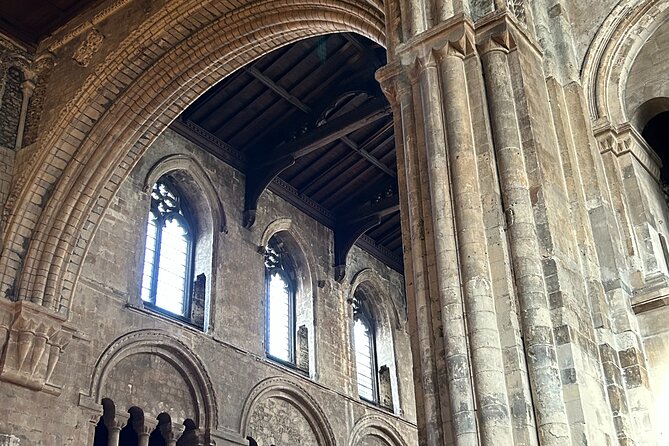
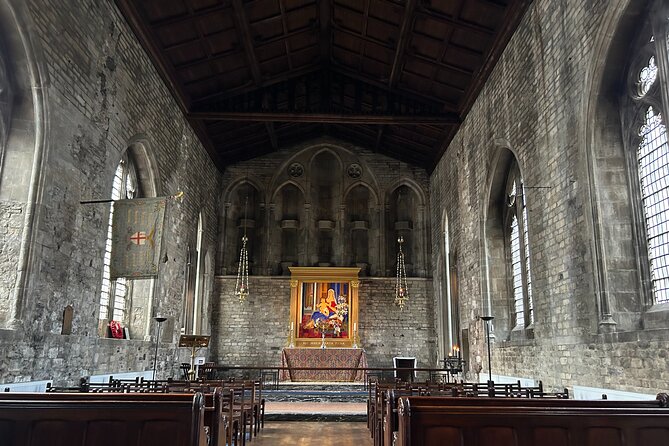
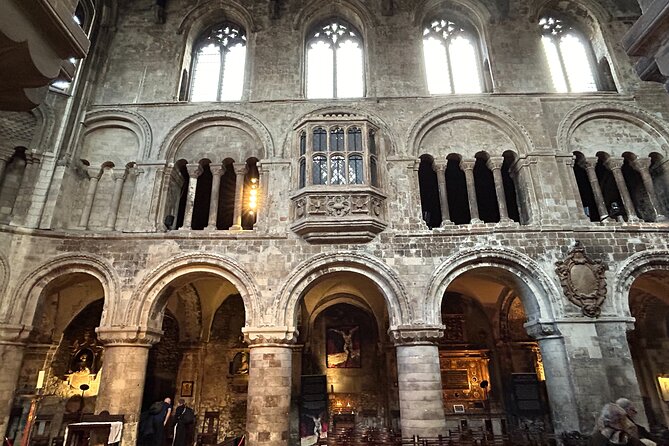
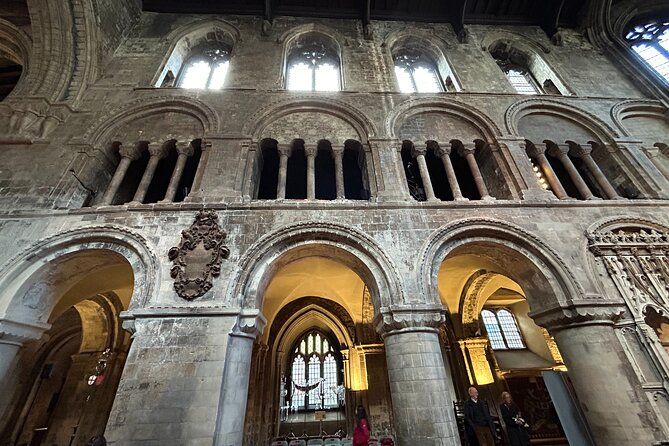
St. Bartholomew the Great is the first major interior visit, with about 45 minutes set aside for the church. It dates from the 12th century and retains much of its early Norman character.
Inside, you can expect to see heavy arches, columns, and tombs, especially toward the eastern side. The architecture offers a clear contrast with later medieval churches, which is one reason this stop matters. Dr Geoff can help you notice the forms and building choices rather than simply telling you that the church is old.
The church survived a remarkable series of threats. It escaped the Great Fire of 1666, endured the changes brought by the Reformation, made it through the Civil War, and survived the bombing of the Second World War. Few buildings can carry that many layers of London’s past in their walls.
I especially like this part of the route because it gives you something tangible. Medieval history can feel distant when it is presented only through dates and names. Here, the arches and stonework give you a direct sense of the building’s age and changing fortunes.
The church is also a useful reminder that the Great Fire did not erase every trace of medieval London. Much of the old city was lost, but buildings such as St. Bartholomew’s continued into the modern age.
The admission ticket is included. Forty-five minutes should be enough to study the main architectural features and hear the church’s story without turning the visit into a full architectural course. If you want quiet time for photography or private reflection, the guide’s explanation will naturally use much of the stop.
Newgate, the old wall, and the Old Bailey
The next section turns toward Newgate Street, where the focus shifts from religious buildings to the city’s defenses and law courts. You discuss London’s medieval walls and stop at Newgate, one of the old entry points into the city.
Newgate later became famous as a prison. The Old Bailey, London’s criminal court, was built on the site and is still used. That connection makes the stop especially useful: a medieval gate became associated with imprisonment, then with the formal administration of criminal justice.
The stop lasts about 10 minutes and is free. Do not expect a preserved medieval gate rising in front of you. The interest lies in understanding what occupied this part of the city and how its purpose changed over time.
I like the way this brief pause breaks up the church visits. You see that medieval London was not just a religious center. It was also a walled city with controlled entrances, crowded streets, prisons, and courts.
For anyone interested in law, crime, or the practical workings of an old city, Newgate adds welcome variety. It also helps explain why location mattered so much in medieval London. Gates were points of movement, control, and danger, not simply decorative landmarks.
Same country, a completely different day out:
- Stonehenge, Windsor Castle, and Bath from London
★ 4.5 · 18,662 reviews - London Big Bus Hop-On Hop-Off Tour with Optional River Cruise
★ 3.5 · 10,803 reviews - London Small Group Tour of Historical Pubs
★ 5.0 · 10,422 reviews - Stonehenge, Windsor Castle and Bath with Pub Lunch in Lacock
★ 4.5 · 7,402 reviews
Temple Church and the Knights Templar
Temple Church is the final major stop and receives about 45 minutes. It was built in the 12th century by the Knights Templar, the wealthy monk-knights associated with the Crusades and later made famous to a modern audience by The Da Vinci Code.
The church gives the tour a strong finish. Its story combines religion, military power, finance, architecture, and political influence. The Knights Templar were not simply soldiers. Their wealth and international connections made them an important force in medieval Europe.
Inside, pay attention to the stone vaulted ceiling. It survived the Blitz even though bombs fell around the church. The building also survived the Great Fire, although later Victorian restoration altered parts of it. That is an important detail for visitors who assume every old feature is untouched. Survival does not always mean perfect preservation.
The church also has a connection to the Founding Fathers of the United States, which gives the stop a wider reach. Dr Geoff’s background in medieval churches and British history is particularly useful here, since Temple Church rewards questions about architecture, institutions, and the way old English traditions influenced later history.
This is the point where the tour’s subject broadens beyond medieval London. You begin with a city before 1666 and end with a building whose story reaches through the Reformation, the Blitz, and the political traditions connected with the United States.
The tour ends in the garden at Temple Church. That makes the final stop feel like a proper endpoint rather than a quick look before being sent back into the street.
What Dr Geoff adds to the experience
A specialist guide changes the rhythm of a walking tour. Instead of reading a plaque or collecting dates, you can ask why a church looks the way it does, what survived the Fire, or how one institution changed its role over time.
Dr Geoff’s academic work at Oxford focuses on medieval churches and British history. His strength, based on the way the tour is described, is not only factual knowledge but also the ability to connect architecture with events. You can ask questions as you go, and the private format means the discussion stays with your group.
That matters because the subject can become technical. Norman arches, vaulted ceilings, medieval walls, church restoration, and the Reformation are all easier to understand when someone can point to a feature in front of you.
The private arrangement is also useful for groups with different interests. One person may want more church architecture. Another may care about William Wallace, Newgate, or the Knights Templar. A shared guide can adjust the emphasis more easily than a large group tour.
The tour has received consistent praise for Dr Geoff’s friendly manner, clear answers, and command of the subject. One group even continued beyond the expected time because the conversation became so involved. That does not guarantee a longer tour every day, but it suggests the format can become more flexible when your group has plenty of questions.
Is $122.18 per person good value?
The listed cost is $122.18 per person. That is a serious price for a 2.5-hour walking tour, especially if you are comparing it with a large group outing or a self-guided walk.
The calculation changes because this is a private activity. Your group does not share the guide with strangers, and admission to St. Bartholomew the Great and Temple Church is included. You are also paying for a guide with specialist academic training rather than a general city introduction.
I would consider it good value for a couple, family, or small group that wants detailed medieval history and plenty of questions answered. It is less compelling if you mainly want quick photographs of St. Paul’s, Temple Church, and a few old streets.
The route also saves you from piecing together several separate visits. You see two important surviving churches, learn about Newgate and the medieval wall, and hear about William Wallace in one continuous walk.
Food is not listed as a standard part of the stated itinerary, so do not assume lunch is included in the $122.18 price. If a pub meal is important to you, confirm the arrangement before booking.
Practical details for the walk
The total duration is approximately two hours and 30 minutes, including the walking time from St. Paul’s to Temple Church. You should wear comfortable shoes and be ready for city walking rather than a short set of steps between indoor attractions.
The tour is offered in English. Pickup is offered, but the published meeting point is the west end of St. Paul’s Cathedral near the grand stairs. Confirm any pickup request when booking so you know exactly where Dr Geoff will meet you.
A mobile ticket is provided. The experience is near public transportation, and most people can participate. Service animals are allowed.
Weather matters because the experience requires good conditions. If poor weather forces cancellation, you are offered another date or a full refund. You can also cancel for a full refund if you do so at least 24 hours before the 10:00 a.m. start time. Changes or cancellations made within 24 hours are not refunded.
The walk is best scheduled when you have enough energy for a steady urban route and enough attention for detailed explanations. It is not the right choice if you want a relaxed afternoon with minimal walking.
Who will enjoy this tour most?
I would recommend it first to people who already enjoy medieval architecture, British political history, religious institutions, or the story of London’s rebuilding. You do not need a specialist background, but curiosity will make the tour more rewarding.
It also suits anyone who has visited London before and wants something beyond the usual Westminster and Tower of London circuit. St. Paul’s provides a familiar starting point, but the route soon moves into less obvious corners of the city.
Families with older children may appreciate the variety. William Wallace, a famous prison, monk-knights, a surviving Norman church, and wartime survival all offer strong hooks. Very young children may find the architectural detail harder to follow, particularly during the 45-minute church visits.
The tour is also a good match for visitors who prefer conversation over performance. Dr Geoff’s role is that of a historian and guide, not an actor staging medieval scenes. You get explanation, context, and room for questions.
Should you book the Medieval London Walking Tour?
Book it if you want to understand how medieval London survived under the modern city, and if a private guide with an Oxford history background appeals to you. The combination of St. Bartholomew the Great, Newgate, and Temple Church gives you a strong range of subjects in a short time.
Skip it if you want a broad introduction to all of London, a bus tour, or a tour with no fixed walking effort. The price is high for the duration, but it makes sense for a private, specialist-led experience with included church admission.
For history-minded visitors, the most useful feature is the connection between places. You do not simply see old buildings. You learn why they survived, how their purposes changed, and how medieval London still shapes the city around you.
FAQ
Where does the tour start?
The tour starts at the west end of St. Paul’s Cathedral, near the grand stairs, in St. Paul’s Churchyard, London EC4M 8AD.
Where does the tour end?
The tour ends in the garden at Temple Church, Temple, London EC4Y 7BB.
What time does the tour begin?
The scheduled start time is 10:00 a.m.
How long does the walking tour last?
The tour lasts approximately two hours and 30 minutes. This includes the walk from the meeting point at St. Paul’s to the ending point at Temple Church.
Is the tour private?
Yes. Only your group participates in the private tour.
What happens if the weather is poor?
The experience requires good weather. If it is canceled because of poor weather, you can choose another date or receive a full refund.
Just added around London
- Private The Beatles Taxi Tour in London★ 5.0 · 12 reviews
- Dinner and Jazz Cruise on the River Thames★ 4.0 · 140 reviews
- Airport Coach Service from Heathrow to Oxford★ 3.5 · 67 reviews
- The Alfred Hitchcock London Walk with Sandra Shevey★ 5.0 · 15 reviews
- Tower of London & 30+ London Sights Walking Tour★ 4.5 · 33 reviews
- Thames Beachcombing★ 4.5 · 100 reviews
- Ted Lasso Tour of Richmond with Private Guide★ 5.0 · 25 reviews
- Ted Lasso Tour of Richmond★ 5.0 · 152 reviews
Walking Tours, compared.
Oxford University Walking Tour With University Alumni Guide
Read our review →
Tour for Muggles The Ultimate Harry Potter Walking Tour in London
Read our review →
Cambridge University Walking Tour by Alumni™ Kings College Option
Read our review →
Blackbeard to Banksy – The Ultimate Walking Tour of Bristol
Read our review →
Air Raid Shelter + St. Nicholas Market Walking Tour
Read our review →
Walking Tour of Bath with Blue Badge Tourist Guide
Read our review →