
Reviewed · BATH TOURS
Private Guided Tour of Jane Austen’s Bath
Jane Austen’s Bath comes alive through places you can still see today: the rooms where fashionable society gathered, the streets her characters walked, and the house where Austen stayed with her family. This private 2.5-hour walk links those scattered clues into one clear story, from Bath Abbey to Sydney Place.
I like the small-group format, which gives you room to ask questions, and I like the route’s mix of famous sights and precise Austen connections. Theresa is praised for her enthusiasm and entertaining style, while the tour’s main drawback is that it is almost entirely a walking and exterior sightseeing experience, with admission fees not included at several stops.
Key points to know before booking
- A private route for up to six people keeps the pace personal and avoids joining a large group.
- The walk connects Austen’s life and fiction, from her family’s Bath addresses to scenes linked with Northanger Abbey and Persuasion.
- Theresa is one named guide, described as enthusiastic, entertaining, and fully informed about Austen and Bath.
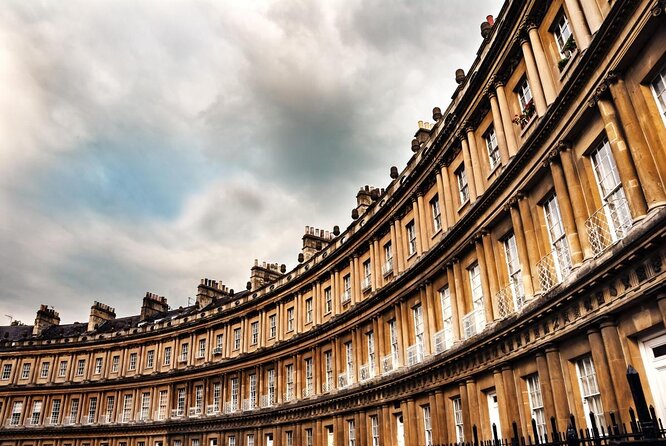
- You pass Bath’s essential Georgian sights, including Bath Abbey, The Circus, Queen Square, the Assembly Rooms, and Pulteney Bridge.
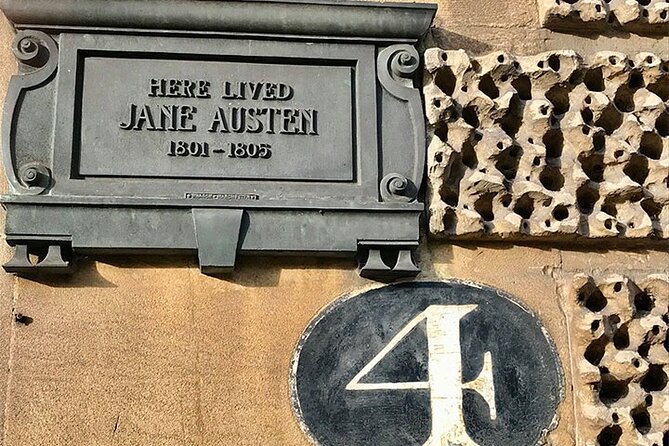
- The tour ends at Sydney Place, near the house where Jane Austen and her family lived at Number 4.
- The price is $205.29 per group, not per person, making it more appealing when six people share the cost.
Why Austen’s Bath works best on foot
Bath is compact enough to walk, but its Austen connections are spread across the city. You can find Bath Abbey on your own, then wander to Queen Square, The Circus, the Assembly Rooms, and Sydney Place. The challenge is knowing which buildings matter and why.
That is the useful part of this tour. You are not simply shown attractive Georgian streets. You are told how Bath’s social life shaped Austen’s fiction and how actual family connections fit into the city’s story.
The walk lasts about two and a half hours. That is enough time to cover a substantial part of central Bath without turning the outing into an all-day commitment. Since the tour is private, your group can ask about a particular novel, pause for photographs, or spend more time on a subject that interests you.
You should still expect a walking tour rather than a sequence of long indoor visits. The listed time at each stop is short, often 10 to 15 minutes. Several sites have admission fees that are not included, so think of the tour price as payment for the guide and route, not a bundled entrance package.
A few more Bath trips to weigh up
- Bath Tour – 3 Hour Private Tour with Local Guide, £220 per group
★ 5.0 · 154 reviews - Stonehenge Private Tour – Half-Day Tour from Bath
★ 5.0 · 145 reviews - BATH: Private Walking Tour | Blue Badge Guide, 2h, £225 per group
★ 5.0 · 66 reviews
Starting at Bath Abbey and Sally Lunn’s
Your meeting point is outside the West Doors of Bath Abbey. The Abbey is a fitting place to begin because it puts you at the heart of old Bath, close to the Roman Baths, the Pump Room, and the streets that formed the center of fashionable life.
The stop is brief, about 10 minutes, and admission is not included. That makes the tour a good orientation to the Abbey rather than a full interior visit. If you want to see the Abbey inside, plan to return separately or ask your guide how best to fit it into your day.
From there, you walk to Sally Lunn’s Museum and tea room. The building occupies Bath’s oldest house, and the food story is part of the appeal. The large, light, yeasty Sally Lunn is often confused with the Bath bun, but they are not the same thing.
The tour links the pastry to Solange Luyon, a young Huguenot refugee who is said to have brought the recipe to Somerset. Austen liked Sally Lunns enough to mention them in her letters, giving you a small but pleasing connection between daily food and literary history.
The stop lasts about 10 minutes, and admission is not included. You can treat it as a quick historical look, then return later for tea if the schedule and your appetite allow. This is one of the tour’s more human details. Austen was not only a novelist moving through grand rooms. She also noticed what people ate.
The Cross Bath, Pump Room, and Austen’s fashionable Bath
The next section moves into Bath’s spa culture. The Cross Bath is a historic bathing pool supplied by natural mineral water and rebuilt by Thomas Baldwin in 1789 in a style associated with Robert Adam.
The point here is not simply the architecture. Bath’s social life revolved around its spa, and the nearby Pump Rooms were a place to see and be seen. Austen used this setting in Northanger Abbey, where Bath society appears as a procession of people showing up during the fashionable hour.
You spend about 20 minutes around the Cross Bath and Pump Rooms. Admission is not included, so the guide’s role is to explain the setting from outside and connect it to Austen’s writing and Regency etiquette.
This is where the tour can help you understand the rules beneath the social scenes. Clothing, introductions, dancing, calling, public appearances, and the right time to be seen all mattered. Austen’s novels depend on those rules, and Bath provides the real streets and rooms behind them.
The practical limitation is time. If you want to bathe, tour the Roman Baths, or visit the Pump Room in detail, you need a separate plan. The walking tour gives you context, not a spa day.
Queen Square and the room where Austen watched Bath
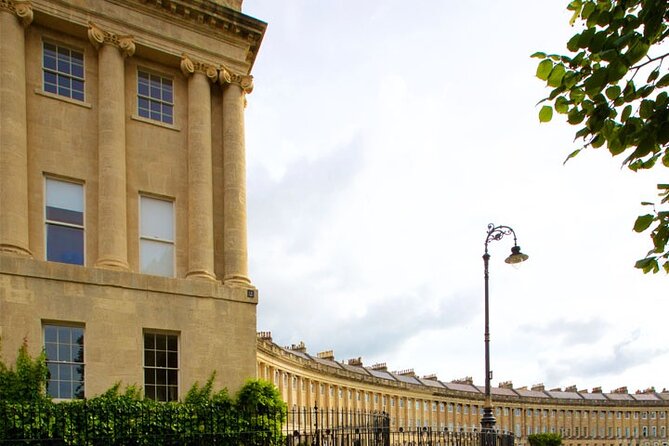
Queen Square gives you one of the clearest links to Austen’s own time in Bath. The square is formed by Grade I listed Georgian houses built in the Palladian style by John Wood the Elder.
In 1799, Austen stayed with her family at Number 13. From her bedroom window, she could watch elegantly dressed people moving through the square while the pale stone buildings caught the sun. That small domestic detail helps make the Austen connection feel specific rather than general.
The guide spends about 10 minutes here. Admission is free, and the square’s open garden gives you space to take in the arrangement of the buildings. An obelisk in the center honors Frederick, Prince of Wales, and is linked with Beau Nash, the famous master of Bath’s social ceremonies.
I like this stop because it joins architecture with observation. Austen’s Bath was a place of display, and Queen Square lets you picture the daily parade from a private bedroom window. Your guide also explains what took place behind the polished doors, where status and good manners shaped social access.
Same country, a completely different day out:
- Walking Tour of Bath with Blue Badge Tourist Guide
★ 5.0 · 1,877 reviews - Stonehenge, Avebury & the Cotswolds from Bath (Small group)
★ 5.0 · 798 reviews - Roman Baths and Bath City Walking Tour
★ 4.5 · 762 reviews - Fully Guided Bath Ghost Tours
★ 5.0 · 539 reviews
The Circus and No. 1 Royal Crescent
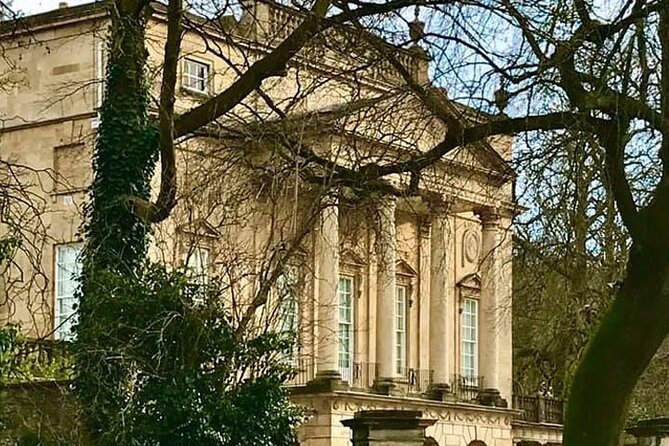
The Circus is one of Bath’s most striking urban designs. John Wood the Elder planned it as part of a classical vision for the city, with curved rows of Georgian houses forming a circular space.
You spend about 15 minutes here. There is no admission charge for viewing the exterior, and the stop is especially useful if you care about architecture as much as Austen. The design tells you how Bath’s builders wanted the city to look to its fashionable residents and visitors.
Your guide adds stories about the people who lived at this address. Those stories help you read the buildings as homes with social ambitions, not just as a photogenic circle of stone.
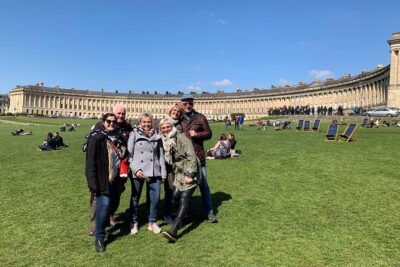
The route then continues to No. 1 Royal Crescent. The crescent contains 30 terraced houses and was designed by John Wood the Younger, with construction taking place between 1767 and 1775. It remains much as it was when first built.
You have about 15 minutes here. Admission is not included, so you will mainly hear about what this street was like during Austen’s time unless you arrange a separate interior visit.
Royal Crescent is one of Bath’s most photographed sights, but the Austen value lies in the social setting. These houses belonged to a city where appearance, address, and connections mattered. The guide’s stories help you understand the kind of world that Austen observed and turned into comedy.
The Assembly Rooms and the rules of Regency evenings
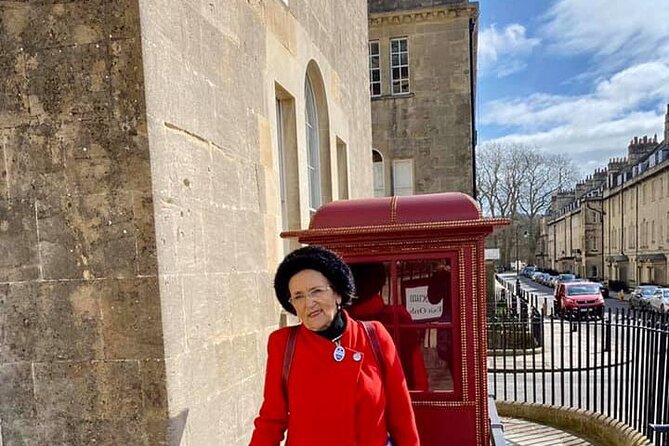
The Assembly Rooms are among the most important Austen stops because they were made for the social activities that fill her Bath scenes. Balls, concerts, and other gatherings took place here, and dancing was an important part of Austen’s own interests.
You spend about 10 minutes outside or around the site, with admission not included. The short stop is enough to explain why this building mattered, but you will need a separate ticket if you want an extended interior visit.
The guide also discusses Austen’s uncle and the investment plan connected with funding the Upper Rooms. That family link adds a useful layer. Austen’s connection to Bath was not only that she lived here and wrote about it. Her family was tied to the city’s institutions and finances.
For me, this is one of the strongest parts of the experience because it gives social etiquette a physical setting. In Austen’s world, a ball was not random entertainment. It was a carefully organized opportunity to meet, judge, avoid, or pursue other people.
Milsom Street and the streets of Austen’s novels
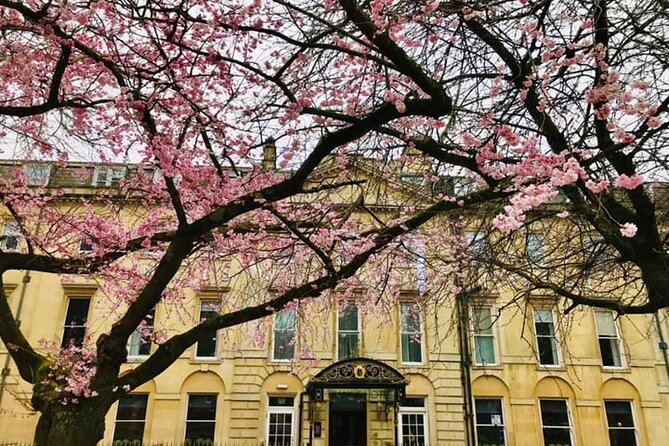
Milsom Street was a fashionable Georgian thoroughfare in Austen’s day, and it remains a shopping street today. It appears in both Northanger Abbey and Persuasion, making this a particularly direct link between Bath’s streets and Austen’s fiction.
The stop lasts about 10 minutes and is free. As you walk there, you pass St Swithin’s Church, where Austen’s parents were married and where her father is buried.
That church connection gives the route a family dimension. The Abbey, Assembly Rooms, and Royal Crescent show public Bath, while St Swithin’s points toward Austen’s parents and the family’s private ties to the city.
Milsom Street also helps you see why location matters in Austen. A fashionable street could be a place for shopping, display, chance meetings, and social judgment. The modern shops change the mood, but the route still gives you a sense of how important a central address could be.
Pulteney Bridge and the River Avon
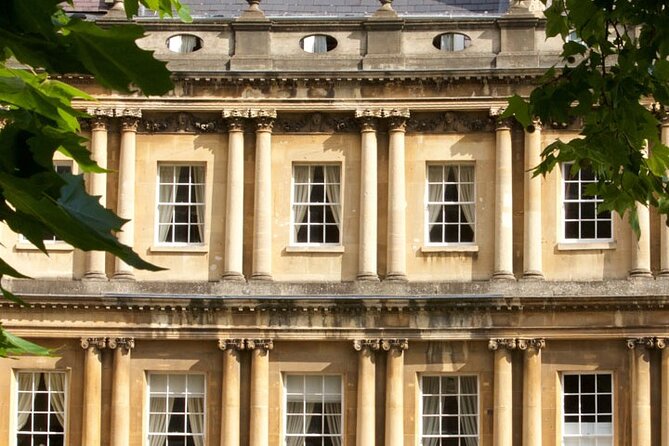
Pulteney Bridge is a short stop, about 10 minutes, and admission is free. Designed by Richard Adam, it crosses the River Avon with shops built along both sides of its full span.
The bridge is unusual enough to deserve attention even without an Austen connection. Its enclosed shopping rows make it feel more like a street than a crossing, and the river gives the walk a change of scale after the dense Georgian squares.
Your guide explains the bridge’s place in Bath’s urban story. It is also a useful point for photographs and a chance to look beyond the formal squares toward the river.
Do not expect a major Austen revelation at every stop. Some parts of the walk are stronger for general Bath history and architecture than for direct literary links. That balance is worth knowing before you book. The tour is about Austen’s Bath, not a museum exhibit devoted only to her books.
Great Pulteney Street and the final walk to Sydney Place
The final stretch follows Great Pulteney Street, a broad Georgian avenue planned by Thomas Baldwin to connect Bath with the River Avon, Bathwick, and Sydney Gardens.
The street is lined with impressive townhouses, and its width gives you a different view of Bath’s planning. Earlier parts of the route focus on squares and crescents. Here, the long avenue creates a grand approach toward the eastern side of the city.
You spend about 15 minutes walking toward Sydney Place. The tour ends at Sydney Place, where Austen and her family lived at Number 4.
Ending there is a smart choice. The route begins among Bath’s public landmarks and finishes at a place connected directly with Austen’s family life. You leave with a clearer sense of how the city’s fashionable center related to the home addresses where Austen actually lived.
The end point is not back at Bath Abbey, so plan your next move. Sydney Place is still in Bath, but you should allow time to orient yourself after the tour, especially if you have a train, meal reservation, or another timed visit.
What the private format is worth at $205.29
The price is $205.29 for a group of up to six people. That works out to about $34.22 per person if six people join, or about $51.32 each for four people. For two people, the cost is much higher per head, but you are paying for a private guide rather than a shared group experience.
That distinction matters. A private tour gives your party control over questions and conversation. You are not waiting for a large group to gather, and the guide can focus on your interest in Austen, architecture, social customs, or particular novels.
I see the strongest value for families, friends, or Austen-focused groups of four to six. At full capacity, the cost is easier to justify, especially if you want a quick introduction before exploring Bath on your own.
The price does not include admission to Bath Abbey, Sally Lunn’s Museum, the Cross Bath, the Pump Rooms, or the Assembly Rooms. You should budget for those separately if you want to go inside. The route itself includes several free exterior stops, including Queen Square, The Circus, No. 1 Royal Crescent from outside, Milsom Street, Pulteney Bridge, and Great Pulteney Street.
Guide style and the role of Theresa
The guide can make or break a walking tour, and the named guide connected with this experience is Theresa. She is described as enthusiastic, entertaining, and fully informed about Jane Austen and Bath.
Those qualities matter here because the subject can easily become a string of dates and addresses. A good guide needs to explain how Austen’s family, Bath society, architecture, etiquette, and novels connect without turning the walk into a lecture.
The company is Strictly Jane Austen Tours. The tour is private, so your guide is working only with your group. That gives you a better chance to ask about a favorite character, a specific passage, or the difference between Austen’s real Bath and the Bath of her fiction.
The available feedback is very strong, with a five-star rating based on seven reviews. The most highly praised points are the guide’s enthusiasm, entertainment, and command of both Austen and the city. You should still remember that a small number of ratings cannot tell you how every guide conducts every departure.
Who should book this Bath walk?
I would choose this tour if you want a focused introduction to Austen’s Bath without doing several hours of research first. It suits readers of Northanger Abbey and Persuasion, people interested in Regency manners, and anyone who wants the main Georgian sights explained in one route.
It also works well as a first Bath activity. You finish knowing where the Abbey, Pump Rooms, Queen Square, The Circus, Royal Crescent, Assembly Rooms, Milsom Street, Pulteney Bridge, and Sydney Place fit together.
You may prefer another plan if you want extensive indoor sightseeing, spa access, or a slower architecture tour. The itinerary moves quickly, and the short stop times mean you will hear more than you will explore inside.
Good walking shoes are sensible, and the experience requires good weather. If poor weather cancels the tour, you are offered another date or a full refund. You can cancel for a full refund up to 24 hours before the start time, but changes or cancellations inside that window are not accepted.
The tour is near public transportation, service animals are allowed, and most people can participate. The use of a mobile ticket also keeps the booking simple.
Should you book Strictly Jane Austen Tours?
Book it if you want Austen, Bath, and Regency social life in one private walk, especially if your group has four to six people. Theresa’s praised style is a strong reason to consider it, and the ending at Sydney Place gives the route a satisfying personal connection to Austen’s family.
Skip it if you expect entrance tickets, long indoor visits, or a tour devoted only to literary analysis. At $205.29 per group, the value depends on group size and your interest in guided context. For an Austen fan who wants the city’s key places tied together by an engaging local guide, it is a practical and well-focused way to get oriented.
FAQ
How long does the Jane Austen Bath tour last?
The tour lasts approximately 2 hours and 30 minutes.
How much does the private tour cost?
The price is $205.29 per group, for up to six people.
Is this a private tour?
Yes. Only your group participates in the activity.
Where does the tour begin?
The meeting point is outside the West Doors of Bath Abbey in Bath.
Where does the tour finish?
The tour ends at Sydney Place in Bathwick, near Number 4 Sydney Place, where Jane Austen and her family lived.
Which major Bath sights are included?
The route passes Bath Abbey, Sally Lunn’s Museum, the Cross Bath, the Pump Rooms, Queen Square, The Circus, No. 1 Royal Crescent, the Assembly Rooms, Milsom Street, Pulteney Bridge, and Great Pulteney Street.
Are admission tickets included?
No. Admission is not included for Bath Abbey, Sally Lunn’s Museum, the Cross Bath, the Pump Rooms, or the Assembly Rooms. Several exterior stops are free.
Is the tour available with a mobile ticket?
Yes. The experience offers a mobile ticket.
Can I cancel for a full refund?
Yes. You can cancel at least 24 hours before the experience start time for a full refund.
What happens if bad weather cancels the tour?
You will be offered a different date or a full refund if the experience is canceled because of poor weather.
Just added around Bath
- Wells, Cheddar Cheese and Cheddar Gorge – Private Day Trip from Bath★ 5.0 · 10 reviews
- BATH: 2-Hour Bath Walking Tour of Bridgerton Filming Locations★ 5.0 · 99 reviews
- The Splendour of Georgian and Victorian Era Bath: A Self-Guided Audio Tour★ 4.0 · 3 reviews
- Stonehenge and Bath City Tour – Private tour from Bath★ 5.0 · 33 reviews
- Secrets of Stonehenge Private Half-Day Tour from Bath★ 5.0 · 6 reviews
- Private Guided Ghost Tour of Bath★ 5.0 · 20 reviews
- Private Tour of Quintessential Wiltshire and Cotswold Villages★ 5.0 · 14 reviews
- Stonehenge Private Full-Day Tour from Bath for 2-8 guests★ 5.0 · 23 reviews
Bath Tours, compared.
Walking Tour of Bath with Blue Badge Tourist Guide
Read our review →
Stonehenge, Avebury & the Cotswolds from Bath (Small group)
Read our review →

Bath Tootbus Hop-on Hop-off Sightseeing Bus Tour
Read our review →Browse the lists this tour appears in